O

Deep Six sits at the northern tip of Similan Island 7, where the island’s granite mass slides below the surface and continues underwater as a formation of massive boulders extending into open water. Swim-throughs, caverns, tunnels, and a named internal chamber known as ‘The Living Room’ make this one of the most topographically complex dives in the Similan Islands. The site is named not for its depth alone but for its former address: it was known as Island 6 before Elephant Head Rock lost island status and the archipelago was renumbered — a piece of Similan diving history unique to this site. Deep Six is an intermediate-to-advanced dive, demanding good air management, and comfort with current.  You can check out our current day trip schedule here.

dive site: Deep Six

Similan Island 7

Dive Site Name Deep Six
Also Known As Occasionally listed alongside West of Eden as the two main dive sites on Island 7. Some older resources refer to it by the historical island numbering context. Not to be confused with West of Eden, which is on the opposite (west) side of the same island.
Island / Area Similan Islands — Island No. 7 (Koh Pa-Yu). Northern tip of the island, where the granite formation continues north underwater as a V-shaped or arrowhead-shaped extension. The site faces north into open water; the tip is the most current-exposed section.
GPS Latitude 8.598273
GPS Longitude 97.636416
Site Type Submerged granite boulder formation extending north from the island tip. Small and massive boulders at multiple levels create swim-throughs, caverns, tunnels, and an internal chamber (‘The Living Room’). Sheer soft-coral walls on some faces. Hard coral garden on the shallow west side of the site at 10–15 m.
Access Day trip and liveaboard. Best scheduled as the first dive of the day due to the depth profile. There is no mooring line on Deep six.  Divers are dropped on one side or the other depending on current.  Typically the drop is north of West of Eden and you swim onto the site following the boulder formation

Depth and Conditions

Minimum Depth 5 m (top of the shallow coral garden and reef on the west and east sides of the northern island tip)
Maximum Depth 35–40 m (sandy seabed at the tip of the V formation and the deepest boulder bases)
Average Depth 12–25 m, where the swim-throughs and the most productive boulder sections are found. Most divers spend the majority of the dive between 15 and 25 m.
Typical Visibility 20–30 m. Good open-water visibility consistent with most northern Similan sites.
Current Moderate to strong, running predominantly south-east to north-west (or the reverse), with the current funnelling and accelerating at the pointed northern tip. Staying close to the boulders is essential on all dives — mid-water in current at this site means being swept off the site and away from the boat. The sheltered natural bay on the west side provides a calmer entry point from which divers move into the site with the current. On strong-current days, the point should be approached with extra care.
Water Temperature 27–30°C throughout the season.
Best Season October to May (Similan Islands National Park season). Best scheduled as a morning dive, first or second of the day, to maximise NDL at depth.
Best Time of Day Early morning, first dive of the day. The deeper sections of the site, particularly the 30–40 m sand plain around the outer boulders, consume NDL quickly and are best dived on a clean slate. A morning entry also tends to coincide with calmer surface conditions for descent.

Diver Suitability

Minimum Certification PADI Advanced Open Water Diver recommended. Deep Six as an ideal site for the PADI Advanced Open Water Deep Adventure Dive and the PADI Deep Diver Specialty Course. The depth (35–40 m to sand), current at the pointed tip, and the complexity of the boulder system place this beyond the appropriate scope of newly certified Open Water divers.
Recommended Experience 30+ dives, Advanced certification, comfortable buoyancy in current. Experience navigating large boulder systems is valuable. Divers with good air management get significantly more from this site than those who run through their tank quickly at depth.
Suitable for Beginners? No. Deep Six is unsuitable for beginners and challenging even for some intermediate divers. The combination of depth, current at the northern tip, and the non-linear boulder layout requires confident dive management throughout. Open Water certified divers should not attempt this site.
Suitable for Advanced? Yes — fully. The swim-throughs, The Living Room, the sheer soft-coral walls, and the deep sand plain are all experiences that reward Advanced certification and the experience that typically accompanies it. This is one of the Similan Islands’ recommended Advanced Open Water deep dive venues for a reason.
Snorkelling Viable? No. The north tip of Island 7 is exposed to current and the site’s features are at diving depth. There is no sheltered snorkel zone associated with Deep Six. Snorkellers in a group should be directed to a sheltered east-side reef.

Suitability Summary

Deep Six is a rewarding intermediate-to-advanced dive that sits between West of Eden (accessible to most certified divers) and Elephant Head Rock (demanding enough that we decline some guest requests) in terms of challenge. The boulder formation, its network of swim-throughs, and the depth of the outer sections make Advanced certification and good current experience the right entry point. Divers who meet those requirements will find a topographically complex, species-diverse site with excellent visibility and the satisfying feeling of a dive that takes planning and skill to do well. It is also one of only a handful of Similan sites specifically recommended for PADI Advanced Open Water deep training dives.

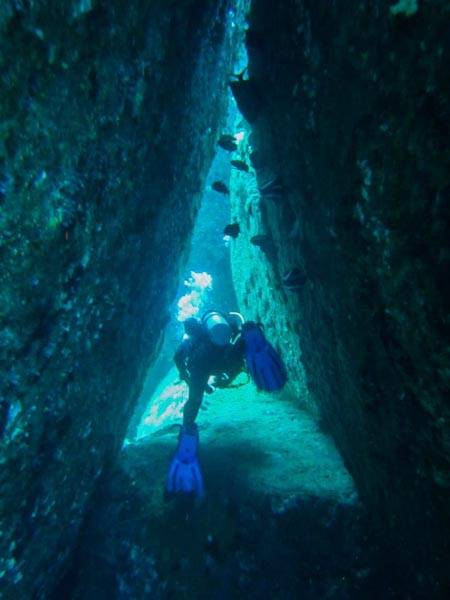
diver in a swimthrough on Deep Six

SITE DESCRIPTION

OVERVIEW — WHAT MAKES THIS SITE SPECIAL

Deep Six takes its name from two things: its depth and its history. The site was previously off what was known as Island 6 in the original Similan numbering. When Elephant Head Rock lost its status as an independent island in the 1980s and the archipelago was renumbered, Island 6 became Island 7 — but the dive site kept its original name. The ‘deep’ part is self-evident: the sandy seabed around the northern tip of the formation reaches 35–40 m, and the site earns its name in both senses.

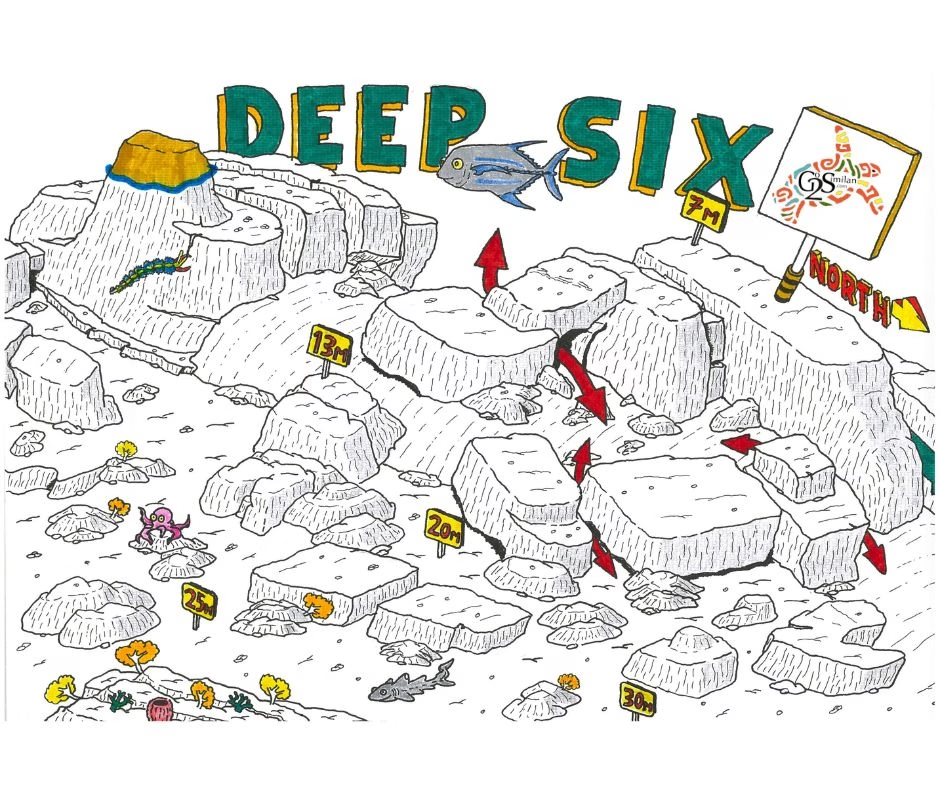
Structurally, Deep Six is unlike any other site on Island 7. Where West of Eden on the west side of the island is defined by its transition from coral garden to boulder canyon, Deep Six is a single unified granite formation — an arrowhead, viewed from above, with the point extending north into open water and the two arms of the V running back south-east and south-west toward the island. The boulders are stacked at multiple levels, creating one of the most complex swim-through systems in the Similan Islands: tunnels that run from 22 m up to 12 m, a 5-metre passageway at 13 m lined with gorgonian sea fans and inhabited by marbled groupers, and a large internal chamber — known locally as ‘The Living Room’ — accessible via swim-throughs from either side of the site.

DIVE ROUTE / LAYOUT

There is no mooring line on Deep Six, and divers usually drop away from the site and let the current take them in as they descend.  My preferred entry is from the west, north of West of Eden and drift onto the site with the boulders on the right.

At around 13 m, you steer into the formation, and look for the entrance to a 5-metre passageway running through one of the larger boulders: inside, the walls are covered in gorgonian sea fans and marbled groupers hold station at the exit. This passage connects to the Living Room.

Two further swim-throughs at approximately 20 m lead from/into The Living Room — a large internal space within the boulder cluster where the ceiling opens and fish congregate. From The Living Room, divers can exit via any of the swimthroughs, going deeper if this is the start of the dive, or shallower if the dive started from the east with the deep sections first.

HIGHLIGHTS & UNIQUE FEATURES

The huge boulders, swimthroughs and the living room are the defining features of this divesite.  Current is a significant factor and can determine not only the entry point, but the whole route as your guide works with the current rather than trying to fight it.

The 5-metre gorgonian passageway at 13 m is the most visually spectacular single feature of the site — a short tunnel lined floor to ceiling with sea fans, the light from each end creating natural silhouettes of the fish stationed inside. Marbled groupers (Epinephelus polyphekadion) are reliably present here, one of the more striking species in the Similan Islands and not commonly seen at other sites.

The eastern side is notably different in character from the west side: where the west side has the hard coral garden and shallower sandy areas, the east side is dominated by giant barrel sponges (Xestospongia testudinaria) and enormous gorgonian sea fans in the 10–15 m range. Red fire gobies (Nemateleotris magnifica) and blennies are found in the crevices between the sponges here in greater numbers than on the western side.

Marine Life

REGULARLY SEEN SPECIES

  • Sharks & rays: Whitetip reef sharks (Triaenodon obesus) in the deeper sections of the boulder system and around the outer tips of the V. Leopard sharks (Stegostoma tigrinum) resting on the sandy seabed at 30–40 m. Kuhl’s stingrays (Neotrygon kuhlii) on sandy patches throughout the site. Blue-spotted stingrays (Neotrygon kuhlii) are reliable and often resting on the sandy plain.
  • Schooling pelagics: Schools of fusiliers (Caesio teres and other species) draw pelagic hunters consistently. Dogtooth tuna (Gymnosarda unicolor), giant trevally (Caranx ignobilis), bluefin trevally (Caranx melampygus), and rainbow runners (Elagatis bipinnulata) circulate around the outer boulders, hunting the fusilier schools. Barracuda (Sphyraena spp.) in loose aggregations.
  • Boulder residents: Giant moray eels (Gymnothorax javanicus) in crevices throughout the boulder system. Marbled groupers (Epinephelus polyphekadion) — reliably found in and around the 13 m gorgonian passageway. Schools of Oriental Sweetlips (Plectorhinchus vittatus) around the larger boulder faces. Humphead parrotfish (Bolbometopon muricatum) occasionally encountered, particularly in the deeper boulder sections. Bannerfish (Heniochus diphreutes) in schools in the mid-water.
  • East side / sponge zone: Red fire gobies (Nemateleotris magnifica) in crevices between the giant barrel sponges (Xestospongia testudinaria) — more reliably found here than on the western side of the site. Blennies (Blenniidae) on the sponge and sea fan surfaces. Unicornfish (Naso spp.) on the boulder faces.
  • West side the boulder wall leading into/out of the site is a guaranteed find for purple flabellina nudibranch (Flabellina-affinis).
  • Shallow sections: Hawksbill turtles (Eretmochelys imbricata) in the hard coral garden on the western shallow section at 10–15 m. Pipefish (Syngnathidae) in small crevices. Octopus (Octopus cyanea) throughout the reef. Nudibranchs (Chromodoris spp. and others) on encrusted boulder surfaces. Frogfish (Antennarius spp.) camouflaged on sponges and coral — worth checking every irregular surface.
  • Coral & structure: Soft corals (Dendronephthya spp.) on the deeper boulder faces and inside the swim-throughs. Gorgonian sea fans throughout, particularly dense in the 13 m passageway and on the eastern boulder faces. Giant barrel sponges (Xestospongia testudinaria) — among the largest in the Similan Islands — on the eastern arm. Hard corals (staghorn Acropora cervicornis, brain coral Platygyra spp.) on the shallow western reef.

SEASONAL / PELAGIC HIGHLIGHTS

Deep Six is unusual among the Similan Islands dive sites in that manta rays and whale sharks are seldom sighted here.  Both species tend to pass by on other Similan dive sites during the season, leaving Deep Six to showcase its resident and schooling species without their presence. This is not a failing of the site — the fusilier schools, pelagic hunters, and swim-through topography more than compensate — but divers specifically seeking manta or whale shark encounters should prioritise Koh Bon, Richelieu Rock, or Koh Tachai Pinnacle on their itinerary.

The site’s strengths are its schooling fish and the pelagic hunters they attract. On days when the fusilier schools are thick around the outer boulders, giant trevally and dogtooth tuna hunting passes through the school are among the most dramatic sights in Similan diving. The whitetip reef shark population at the deeper boulder sections is consistent throughout the season and is a reliable, if not always large, presence on most dives.

PHOTOGRAPHY NOTES

Deep Six is primarily a wide-angle and schooling-fish site. The 13 m gorgonian passageway is the single best photo subject: a fisheye lens shooting toward the light at the far end of the passage, with sea fans framing the shot and a diver or grouper in the exit, produces one of the most visually distinctive images available at any Similan site. Bring a torch — the interior of the passageway is darker than the ambient light at either end suggests, and strobes alone are often insufficient to bring out the sea fan colour.

The fusilier-and-trevally hunting sequences around the outer boulders are best captured with a wide rectilinear or mild fisheye lens: position yourself against a boulder face and shoot across the school as the trevally charge through. Anticipate the hunting passes rather than chasing — trevally move faster than a diver can track. The giant barrel sponges on the east side, some exceeding a metre in diameter, make excellent compositional anchors with red fire gobies at the rim edge: use a 60–100 mm lens and approach from below the goby to separate it from the sponge background. The shallow hard coral garden on the western arm, despite the visible tsunami damage, photographs well in natural morning light with a wide rectilinear lens at mid-depth.

Deep Six FAQs

No. Deep Six is unsuitable for beginners and challenging for some intermediate divers. The depth (35–40 m to sand on the outer sections), the moderate-to-strong current at the point, and the non-linear boulder layout all require confident dive management throughout. PADI Advanced Open Water certification and at least 30 logged dives are the right starting point. It is, however, specifically recommended as one of the best Similan Islands sites for the PADI Advanced Open Water Deep Adventure Dive and the PADI Deep Diver Specialty Course — so if you are working toward either qualification on a liveaboard trip, Deep Six is a reasonable choice.

The name comes from the site’s original island address. In the original Similan numbering system, the site was located off Island 6. When Elephant Head Rock — previously counted as its own island — lost its island status in the 1980s and the archipelago was renumbered, Island 6 became Island 7. The dive site kept the name that had already been established among the diving community. The ‘deep’ part is equally apt: the sandy seabed at the outer tip of the formation reaches 35–40 m.

Deep Six offers excellent reef and schooling species but rarely produces manta rays or whale sharks —these species tend to visit other Similan sites during the season rather than Deep Six specifically. What the site reliably delivers is: large schools of fusiliers attracting dogtooth tuna, giant and bluefin trevally, and rainbow runners; whitetip reef sharks in the deeper boulder sections; leopard sharks on the sand; Kuhl’s stingrays; giant moray eels and marbled groupers in the boulder crevices and the gorgonian passageway; red fire gobies on the eastern sponge walls; hawksbill turtles in the shallow coral garden; and nudibranchs, pipefish, and frogfish on the encrusted boulder surfaces.

The site ranges from 5 m on the shallow coral sections to 35–40 m on the sandy seabed at the outer tip. The most productive swim-through zone is between 12 and 22 m. The Living Room is the local name for a large internal chamber within the boulder system, accessible via two swim-throughs at around 20 m from either the eastern or western side, and a wide swimthrough at 13 metres at the South. It is a significant open space inside the boulder formation — large enough for a small group to convene inside — where fish congregate and the granite walls around create an atmospheric enclosed-but-open effect. It is one of the most memorable features of the site and the landmark that experienced guides use to orient the group mid-dive.

No. The northern tip of Island 7 where Deep Six is located is exposed to current, and the site’s features are all at diving depth. There is no sheltered bay associated with Deep Six that is suitable for snorkelling. On Island 7 day trips and liveaboards, the sheltered eastern side (sometimes referred to as ‘shallow six’) offers the appropriate snorkelling alternative for non-diving companions. On a full Island 7 dive day, West of Eden on the western side of the island is a better choice for mixed-ability groups that include snorkellers.

Current at Deep Six runs predominantly south-east to north-west or in the reverse direction, and is moderate to strong on most dives. The point is the most exposed section — current accelerates here and can push divers off the site into mid-water if they leave the protection of the boulders. The standard technique is to stay close to the rocks throughout the dive and use the boulder formation for shelter rather than attempting to swim across the current in open water. Follow your guides directions closely as they manage the dive within the current.  On strong-current days the guide will avoid the point entirely and route the dive along the more sheltered inner sections of the formation.

Ann Christmas - Padi Course Director

Ann Christmas
PADI Course Director

Post Author