dive site: west of eden

Similan Island 7

Dive Site Name

West of Eden

Also Known As

West of Six (historical; Koh Pa-Yu was formerly numbered Island 6 before Elephant Head Rock lost island status)

Island / Area

Similan Islands — Island No. 7, Koh Pa-Yu. West side, northern section. Approximately 200 m south of the island’s north-western tip.

GPS Latitude

8.5938

GPS Longitude

97.6368

Site Type

Granite boulder reef with fringing hard coral garden (southern section) and large boulder canyon system (northern section)

Access

Boat only — day trip or liveaboard. No shore entry.

Depth and Conditions

Minimum Depth

8 m (top of southern coral garden; boulders begin at 12 m)

Maximum Depth

30 m (recreational limit; boulders continue beyond 40 m)

Average Depth

17–20 m

Typical Visibility

20–30 m; peak season (November–March) regularly exceeds 25 m

Current

Moderate to strong. Current direction is almost exclusively south-to-north, regardless of tide tables. On strong-current days this becomes an excellent drift dive. Occasional down-currents near the larger boulder faces as you approach Deep 6.

Water Temperature

27–30°C throughout the dive season. A notable thermocline — known locally as the ‘green monster’ — can bring cold, low-visibility water (approx. 23°C, 5 m viz) with strong multi-directional currents.  It is usually experienced at depth; it passes quickly, usually within a couple of minutes

Best Season

November to April for best visibility and calmest conditions. The Similan Islands National Park is open 15 October to 15 May.

Best Time of Day

Morning dives benefit from calmer surface conditions and good light penetration into the boulder canyons. Afternoon light angles are dramatic on the sea fan walls.

Diver Suitability

Minimum Certification

PADI Open Water Diver — the coral garden on top of the canyons and the bay just south of the main site are both within the 18 m limit. The deeper canyon and boulder section (18–30 m) requires PADI Advanced Open Water.

Recommended Experience

25+ dives. Confident buoyancy control is essential near the canyons and sea fans. Drift diving experience is an advantage on current days.

Suitable for Beginners?

Yes, in the southern coral garden section (8–15 m) and more so in the bay. If you are not confident with your buoyancy and directional control you should not dive the canyon area. 

Suitable for Advanced?

Yes — the deeper boulder sections, walls, and canyons reward Advanced certified divers. Strong-current days offer an exceptional drift experience with pelagic action.

Snorkelling Viable?

Partially.  Snorkelling is possible in calm conditions in the bay, but not the primary use of this site.

Suitability Summary

West of Eden suits Open Water certified divers and above, though the site truly comes into its own for Advanced divers who can explore the full depth range of the boulder canyon system. The southern coral garden is a gentle, colourful introduction at 8–15 m; the northern granite boulders demand good buoyancy and, on stronger current days, a willingness to drift.

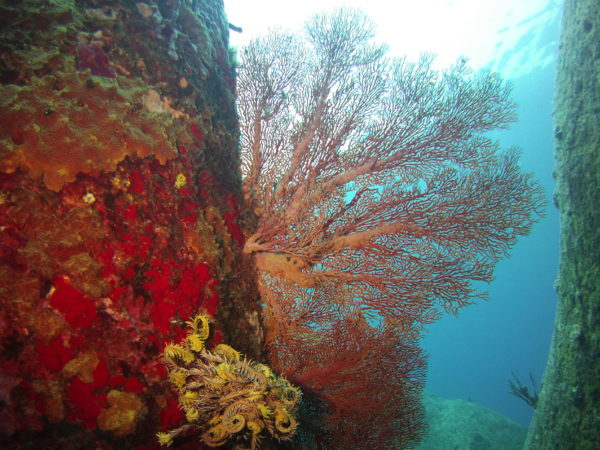
Gorgonian sea fan and soft coral on the granite boulder wall at West of Eden, Similan Island 7, Thailand

SITE DESCRIPTION

OVERVIEW — WHAT MAKES THIS SITE SPECIAL

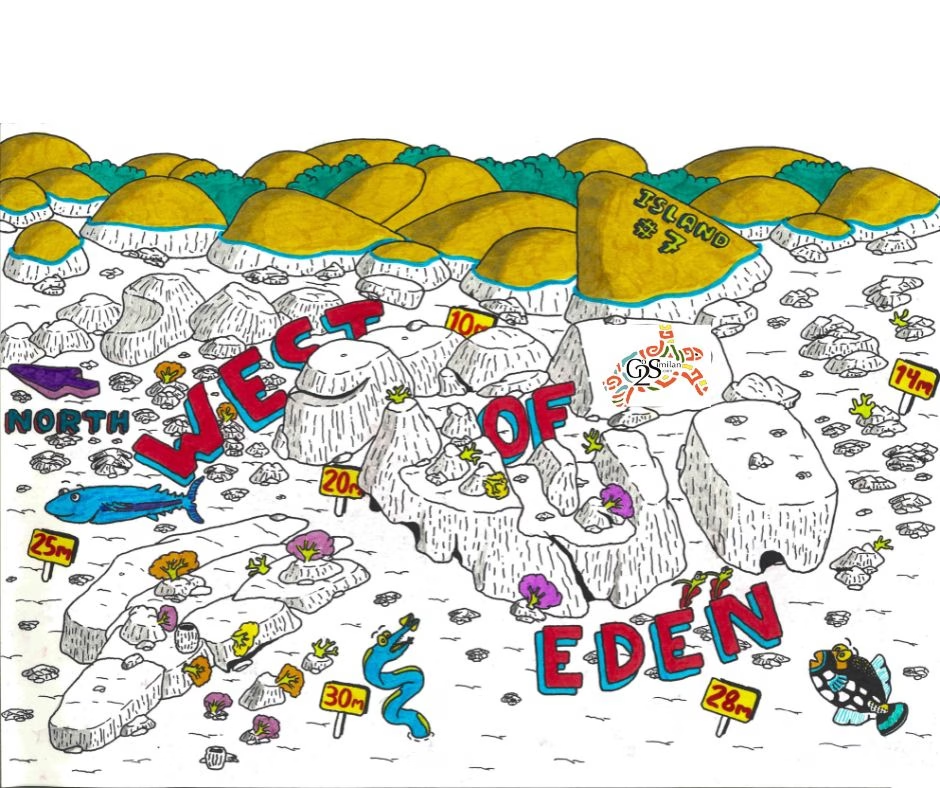
West of Eden sits on the western coastline of Similan Island No. 7 (Koh Pa-Yu) and is widely considered the best dive site on the western side of the Similan Islands. Where many Similan sites offer either a reef or a boulder dive, West of Eden delivers both in a single descent: a pristine hard coral garden in the south transitions seamlessly into a dramatic landscape of cathedral-sized granite boulders stacked into canyons, swim-throughs, and dark crevices to the north.

Walls and boulder faces are densely encrusted with gorgonian sea fans, soft corals, feather stars, and sponges. Add a permanent current running south-to-north and a marine life list that spans reef sharks, resident ribbon eels, ghost pipefish, and, rarely, whale sharks, and West of Eden earns its reputation as a site divers return to year after year.

DIVE ROUTE / LAYOUT

Day trip and liveaboard boats drop you approximately 200 m south of the island’s north-western tip. The entry point drops into 15–20 m of water, typically beginning in the smaller boulders and hard coral field of the southern section, or even in the bay if the current is strong.

From the entry, divers head north with the prevailing current, passing through the hard coral garden — notable for a rare mix of table corals (Acropora hyacinthus), staghorn corals (Acropora cervicornis), and brain corals (Platygyra spp.) in close proximity. As you move north the terrain rises into the boulder section, where the route threads through canyon passages and around massive granite faces covered in gorgonians. Keep your eyes on the sand at depth for ribbon eels and mantis shrimp. The dive ends drifting north towards, and on days when current is running well, the site flows naturally into a drift toward the nearby Deep Six site for air-conscious and well-timed divers.

HIGHLIGHTS & UNIQUE FEATURES

The dual personality of the site — coral garden meeting granite boulders — is West of Eden’s defining feature, rarely found in a single dive at the Similans. The boulder canyons create natural swim-throughs framed by enormous orange and purple gorgonian sea fans, some spanning more than a metre across. At around 25–28 m, a resident ribbon eel (Rhinomuraena quaesita) has occupied the same sandy crevice for several years — a reliable highlight for macro photographers. Nearby, a pair of purple fire gobies (Nemateleotris decora) hover at the crevice entrance.

One boulder in the northern section produces an audible creaking sound as it shifts slightly in current or swell — an eerie, memorable sensation mid-dive. The sand channels between boulders are productive hunting ground for spearing mantis shrimp (Lysiosquillina maculata), and ghost pipefish (Solenostomus spp.) are regularly found hovering near crinoids on the boulder walls. The rare seamoth (Pegasus volitans) has been recorded at this site, and frogfish (Antennarius spp.) are spotted with enough regularity that it is worth checking every encrusted surface carefully.
Marine Life

REGULARLY SEEN SPECIES

  • Fish:  Schools of yellowfin goatfish (Mulloidichthys vanicolensis) and bluefin trevally (Caranx melampygus) patrol the reef edge. Giant trevally (Caranx ignobilis) cruise the mid-water, and yellowback fusiliers (Caesio teres) and neon fusiliers (Pterocaesio tile) sweep past in large shoals. Unicornfish (Naso spp.), sweetlips (Plectorhinchus spp.), and groupers (Epinephelidae) are common residents of the boulder faces.
  • Sharks / Rays:  Leopard sharks (Stegostoma tigrinum) rest on the sandy bottom in the morning, particularly near the boulder bases. Whitetip reef sharks (Triaenodon obesus) are a fairly reliable sighting, often found resting motionless on the seabed or in shallow boulder crevices. Blacktip reef sharks (Carcharhinus melanopterus) are seen cruising in the mid-water, particularly on current days. Blue-spotted stingrays (Neotrygon kuhlii) rest on sandy patches between boulders.
  • Critters & Macro: Ribbon eels (Rhinomuraena quaesita) at 25–28 m — a long-term resident. Purple fire gobies (Nemateleotris decora) and red fire gobies (Nemateleotris magnifica) near the boulder crevices. Ghost pipefish (Solenostomus spp.) associated with crinoids on the walls. Seamoths (Pegasus volitans) and frogfish (Antennarius spp.) on encrusted surfaces. Spearing mantis shrimp (Lysiosquillina maculata) in sand channels. Tiger cowrie shells (Cypraea tigris). Octopus (Octopus cyanea) in boulder crevices. Nudibranchs (Chromodoris spp. and others) throughout the site.
  • Coral: The southern section hosts some of the best-preserved hard coral in the Similan Islands, including table corals (Acropora hyacinthus), staghorn corals (Acropora cervicornis), and brain corals (Platygyra spp.). Boulder walls carry large gorgonian sea fans (Gorgonia spp. and Subergorgia spp.), sea whips, feather stars (Crinoidea), and colourful soft corals and sponges that become denser with depth.

SEASONAL / PELAGIC HIGHLIGHTS

Manta rays (Mobula birostris) are very occasionally seen here, particularly at the season opener in October and November.  Sightings are definitely not guaranteed but are occasional across the Similan Islands as a whole during this window. Schools of dogtooth tuna (Gymnosarda unicolor) and barracuda (Sphyraena barracuda) become more active and visible in the water column on days when current is running strongly, hunting the fusilier schools that are a constant feature of the site.

Hawksbill turtles (Eretmochelys imbricata) and green turtles (Chelonia mydas) are seen throughout the season, feeding on sponges and corals in the coral gardens.

PHOTOGRAPHY NOTES

West of Eden rewards both wide-angle and macro photographers. Wide-angle shooters should target the large gorgonian sea fans with ambient light — morning dives give the best natural light angles into the canyon passages. The hard coral garden in the south is exceptional for reef-scape shots with a fisheye lens. For macro, the sandy channels between boulders and the crinoids on the walls are the most productive areas: ribbon eels, ghost pipefish, nudibranchs, and fire gobies are all approachable with patience. The huge boulders make for an atmospheric wider shot with a diver in frame for scale. Bring a torch — the canyon interiors hide far more than ambient light reveals.

Suitability Summary

West of Eden suits Open Water certified divers and above, though the site truly comes into its own for Advanced divers who can explore the full depth range of the boulder canyon system. The southern coral garden is a gentle, colourful introduction at 8–15 m; the northern granite boulders demand good buoyancy and, on stronger current days, a willingness to drift.

West of Eden FAQs

Yes, with conditions. The southern hard coral garden section at 8–15 m is entirely within the Open Water certification depth limit and is gentle enough for newly certified divers under divemaster supervision. However, the prevailing south-to-north current means beginners must be briefed carefully and stay close to their guide. On stronger current days, West of Eden is better suited to Advanced certified divers with prior drift experience. We assess current conditions on the morning of each trip before deciding whether beginner divers enter the water at this site.

West of Eden is one of the most species-rich sites in the Similan Islands. Reliable sightings include whitetip and blacktip reef sharks, leopard sharks resting on the sand, hawksbill and green turtles, moray eels, blue-spotted stingrays, and large schools of bluefin trevally, giant trevally, and fusiliers. Macro fans will find ribbon eels, purple fire gobies, ghost pipefish, frogfish, nudibranchs, seamoths, and tiger cowrie shells. Manta rays are occasional visitors between November and March. The hard coral garden also supports one of the healthiest coral communities in the Similan Islands.

The Similan Islands National Park is open from mid-October to mid-May. Peak visibility at West of Eden is November through March, when 25–30 m visibility is common and sea conditions are calmest. November is particularly good for pelagic species such as whale sharks and manta rays at the season opener. The beginning of April is still good with warm clear water but the season drops off quickly after the Thai Songkran holiday (13th April) with fewer visitors and progressively fewer trips running as the monsoon season starts to move in. Avoid the south-west monsoon season (Mid May–Mid October) when the National Park is closed and the Andaman Sea is not diveable from Khao Lak.


The site begins at approximately 8 m in the southern coral garden and reaches 30 m at the base of the main boulder system — the recreational diving limit we observe on all trips. The boulders continue descending well beyond 40 m, but this is outside recreational diving limits. Open Water certified divers (18 m maximum) can fully enjoy the coral garden in the bay and upper boulder section. The deeper canyon walls and most productive critter spots are between 20–30 m, making Advanced Open Water certification the recommended level for the complete experience.

Partially. The southern end of the site has a fringing reef that reaches close to the surface, but the western side of Koh Pa-Yu is more exposed than the island’s eastern beaches and surface chop can make snorkelling uncomfortable. On calm days, snorkelling above the coral garden is possible and rewarding. However, the real highlights of West of Eden — the boulder canyons, sea fans, ribbon eels, and reef sharks — are at diving depth. For snorkelling in the Similan Islands, we would typically recommend the shallower, more sheltered sites on the eastern sides of islands 4 and 8.

Current at West of Eden runs south-to-north almost without exception — an unusual characteristic noted by local guides for decades, regardless of what tide tables suggest. Strength ranges from mild to strong depending on the season and conditions on the day. A mild-to-moderate current makes for a pleasant drift dive; a strong current brings pelagic species into the water column and is genuinely exciting for experienced divers but unsuitable for beginners. There are no strong tidal rips or unpredictable surge at this site, but the down-current potential near large boulder faces means divers should maintain good buoyancy at all times.