SITE DESCRIPTION
OVERVIEW — WHAT MAKES THIS SITE SPECIAL
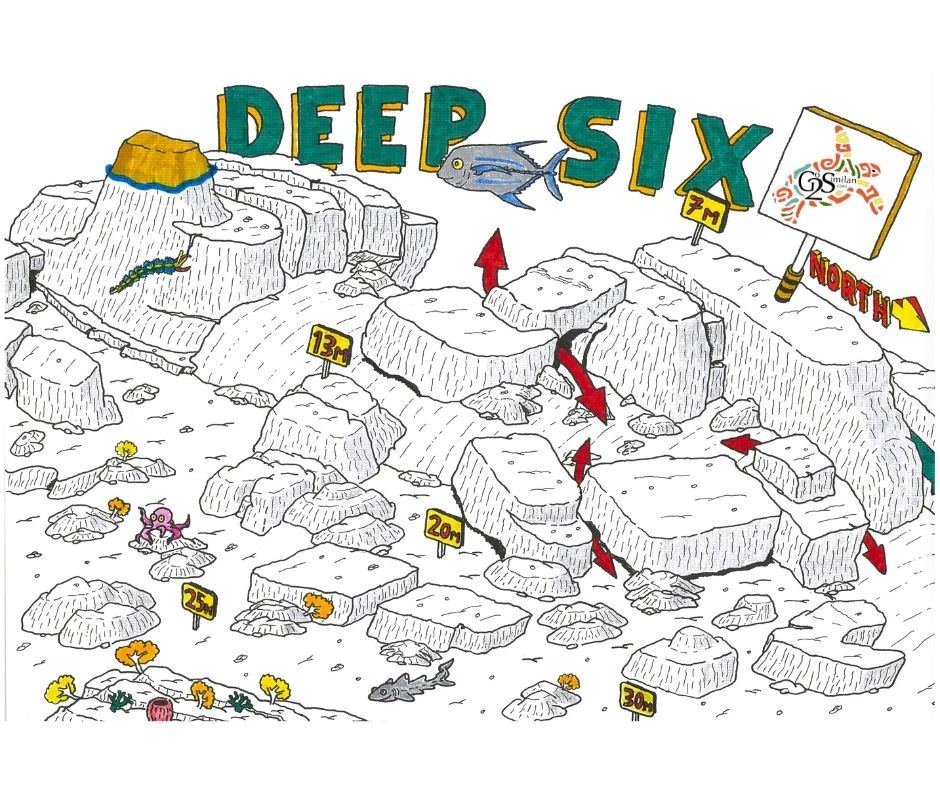
Deep Six takes its name from two things: its depth and its history. The site was previously off what was known as Island 6 in the original Similan numbering. When Elephant Head Rock lost its status as an independent island in the 1980s and the archipelago was renumbered, Island 6 became Island 7 — but the dive site kept its original name. The ‘deep’ part is self-evident: the sandy seabed around the northern tip of the formation reaches 35–40 m, and the site earns its name in both senses.
Structurally, Deep Six is unlike any other site on Island 7. Where West of Eden on the west side of the island is defined by its transition from coral garden to boulder canyon, Deep Six is a single unified granite formation — an arrowhead, viewed from above, with the point extending north into open water and the two arms of the V running back south-east and south-west toward the island. The boulders are stacked at multiple levels, creating one of the most complex swim-through systems in the Similan Islands: tunnels that run from 22 m up to 12 m, a 5-metre passageway at 13 m lined with gorgonian sea fans and inhabited by marbled groupers, and a large internal chamber — known locally as ‘The Living Room’ — accessible via swim-throughs from either side of the site.
DIVE ROUTE / LAYOUT
There is no mooring line on Deep Six, and divers usually drop away from the site and let the current take them in as they descend. My preferred entry is from the west, north of West of Eden and drift onto the site with the boulders on the right.
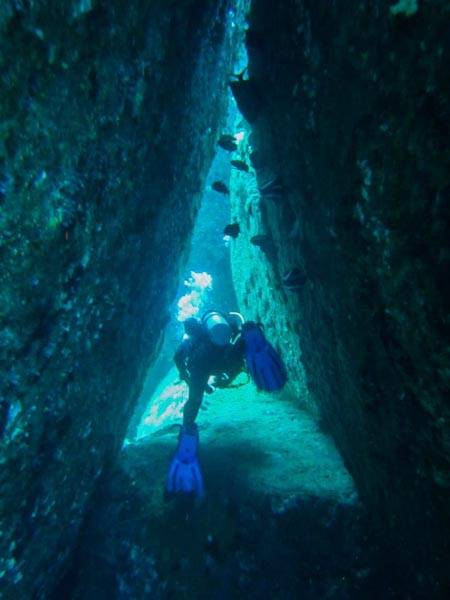
At around 13 m, you steer into the formation, and look for the entrance to a 5-metre passageway running through one of the larger boulders: inside, the walls are covered in gorgonian sea fans and marbled groupers hold station at the exit. This passage connects to the Living Room.
Two further swim-throughs at approximately 20 m lead from/into The Living Room — a large internal space within the boulder cluster where the ceiling opens and fish congregate. From The Living Room, divers can exit via any of the swimthroughs, going deeper if this is the start of the dive, or shallower if the dive started from the east with the deep sections first.
HIGHLIGHTS & UNIQUE FEATURES
The huge boulders, swimthroughs and the living room are the defining features of this divesite. Current is a significant factor and can determine not only the entry point, but the whole route as your guide works with the current rather than trying to fight it.
The 5-metre gorgonian passageway at 13 m is the most visually spectacular single feature of the site — a short tunnel lined floor to ceiling with sea fans, the light from each end creating natural silhouettes of the fish stationed inside. Marbled groupers (Epinephelus polyphekadion) are reliably present here, one of the more striking species in the Similan Islands and not commonly seen at other sites.
The eastern side is notably different in character from the west side: where the west side has the hard coral garden and shallower sandy areas, the east side is dominated by giant barrel sponges (Xestospongia testudinaria) and enormous gorgonian sea fans in the 10–15 m range. Red fire gobies (Nemateleotris magnifica) and blennies are found in the crevices between the sponges here in greater numbers than on the western side.