North Point

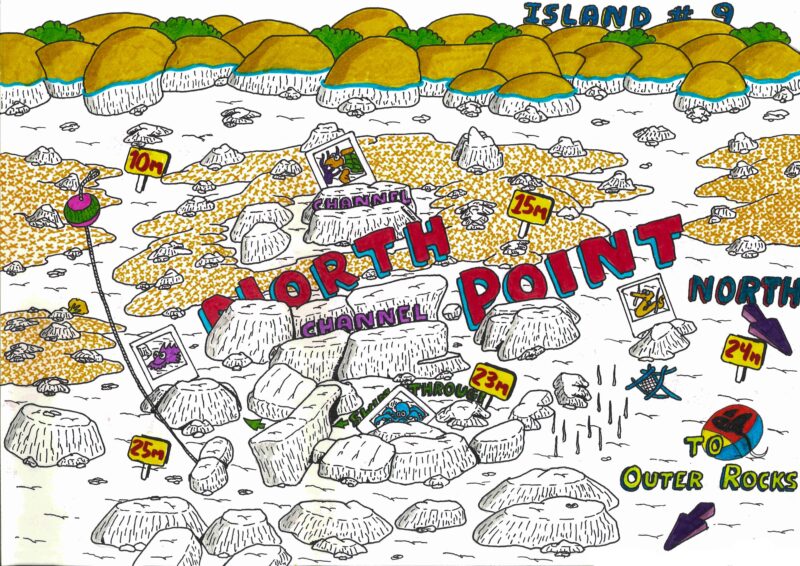
North Point — also known as Rocky Point — sits at the northernmost tip of Similan Island 9, the furthest point north in the entire Similan archipelago. A cluster of massive granite boulders extends from the island into open water, creating a maze of swim-throughs and channels at 20 m, with an enormous shallow field of finger coral close to the island that is home to some of the most reliably seen turtles in the Similan Islands. An optional advanced extension to the North Point Pinnacle — a submerged structure to the north-west covered in giant sea fans — adds depth and challenge for experienced divers. North Point is often reached as a natural extension of a Three Trees drift dive on strong-current days, and stands on its own as a scheduled dive on liveaboard itineraries. Suitable for intermediate divers and above, with shallow sections accessible to Open Water certified divers in calm conditions.
dive site: North Point

SIMILAN Island 9

Dive Site Name

North Point

Also Known As

Rocky Point (used equally by many operators and liveaboards). Both names refer to the same site. The more northerly of the two main dive sites on Island 9, the other being Three Trees / Breakfast Bend on the east side.

Island / Area

Similan Islands — Island No. 9 (Koh Bangu). Northern tip of the island. The site extends north and north-west from the island tip into open water, with boulders going progressively deeper the further from the island they sit. The northernmost point in the entire Similan Islands dive area.

GPS Latitude

8.6750

GPS Longitude

97.6417

Site Type

Cluster of large granite boulders extending north and north-west from the island tip, with sandy patches between them. Swim-throughs and channels at 15–20 m. Large shallow hard coral field (predominantly finger coral, Porites furcata) close to the island at 2–5 m. Optional extension to the North Point Pinnacle north-west of the main site.

Access

Liveaboard and day trip. North Point is a scheduled dive on most Similan liveaboard itineraries. It is also frequently reached as a natural drift extension from Three Trees / Breakfast Bend on the east side of the island when current is running north. The site has a mooring line on the central boulder cluster.  Check out our day trip schedule here.

Depth and Conditions

Minimum Depth

2–5 m (finger coral field close to the island; one channel near the island is as shallow as 5 m)

Maximum Depth

35–40 m (outer northern boulders). The North Point Pinnacle extension drops to 40–45 m, which exceeds recreational diving limits.

Average Depth

10–25 m. Central boulders and swim-throughs at 15–20 m; the finger coral field at 2–5 m; outer northern boulders at 25–35 m.

Typical Visibility

20–30 m. The northernmost position of the Similan Islands and the depth of the surrounding ocean contribute to excellent open-water clarity. Visibility here is consistently among the best in the archipelago.

Current

Moderate to strong. The northern exposure means the site receives current from the open Andaman Sea with no island mass to the north providing shelter. Current runs broadly east to west or west to east along the island tip. On strong-current days divers should stay close to the boulders at all times — crossing open water mid-water against current is tiring and risks being swept off the site. The North Point Pinnacle extension must not be attempted in strong current (approximately 80 m of open-water swimming each way).

Water Temperature

27–30°C throughout the season.

Best Season

October to May (Similan Islands National Park season). The site is accessible throughout the season and is popular as a first or last dive of an Island 9 stop. Often reached as a drift from Three Trees in the north-running current.

Best Time of Day

Morning for the calmest surface conditions. The finger coral field is particularly rewarding at sunrise when turtles are most active on the reef. Sunset dives are possible when the liveaboard is moored on the north side of Island 9 and current is mild.

Diver Suitability

Minimum Certification

PADI Open Water Diver for the finger coral field and the shallower boulder sections (2–18 m) in mild current. PADI Advanced Open Water recommended for the main boulder and swim-through system (15–25 m)

Recommended Experience

10+ dives for the main site in mild current. 20+ dives for the site in moderate-to-strong current.

Suitable for Beginners?

With caveats. On a low-current day, the finger coral field at 2–5 m and the canyon in the shallower section of the boulder system are accessible to newly certified Open Water divers. This is also where the turtles are most reliably seen — so beginners do not miss the site’s headline encounter by staying shallow. In moderate-to-strong current the site is challenging for inexperienced divers.

Suitable for Advanced?

Yes, fully. The deeper outer boulders at 25–35 m and the optional North Point Pinnacle are Advanced-level experiences. The pinnacle, with its giant sea fans and 40 m+ depth, is one of the most impressive structures in the Similan Islands but is rarely dived by most visiting groups, as it is outside normal recreational limits.

Snorkelling Viable?

Partially. The finger coral field at 2–5 m is shallow enough to snorkel above, and the sheltered area close to the island provides calmer surface conditions than the open boulder sections to the north.

Suitability Summary

North Point is broadly accessible to intermediate divers and has genuinely beginner-friendly sections in calm conditions — placing it in a similar category to Three Trees, though the northern exposure means current is a more significant variable here. On a low-current day, Open Water certified divers can access the main channel as well as the finger coral field and the shallower boulder sections, and have as good a chance as anyone of seeing the resident turtles. Advanced divers can explore the full depth range of the main site  For mixed-ability groups, North Point and Three Trees together give a complete Island 9 day: sheltered reef on the east, exposed boulders and finger coral on the north.

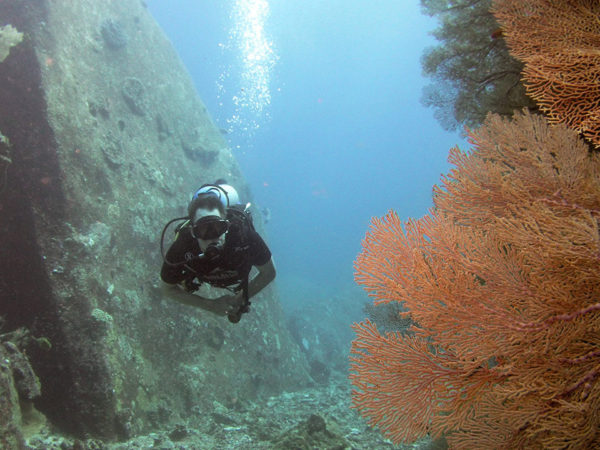
Diver swimming through one of the channels at North Point, Similan Island 9

SITE DESCRIPTION – North Point

OVERVIEW — WHAT MAKES THIS SITE SPECIAL

North Point stands at the very top of the Similan Islands archipelago — the northernmost dive site in the entire group. The name is straightforward and accurate: this is the north point of Island 9, and it faces out into open Andaman Sea with nothing between it and the horizon to the north. The granite boulders that make up the site continue the characteristic Similan pattern — massive formations stacked into canyons and swim-throughs — but the defining feature here that sets it apart from every other Island 9 site is the enormous field of finger coral (Porites furcata) close to the island, which covers an area described by multiple dive operators as larger than a football field and rises to within 2–5 m of the surface.

This shallow finger coral field is reliably home to green and hawksbill turtles, which can be found grazing here throughout the season. It is the kind of feature that rewards unhurried exploration — divers who drop down to the main boulder system and come back up through the finger coral field at the end of the dive regularly find that the last ten minutes, at 2–5 m with turtles possible, are the most memorable part.

DIVE ROUTE / LAYOUT

The mooring line is positioned on the central boulder cluster, with the main boulder system spreading north and north-west at progressively greater depths. The standard dive route begins with a descent to the central boulders at 15–20 m, working through the swim-throughs and channels that run east–west across the formation. Two main channels formed by boulders standing side by side run close to the island; the larger channel connects to the finger coral field. A second, smaller channel at around 12 m is a productive area for nudibranchs and cowries, running from west to east and looping back to the main field.

From the central boulders, the route heads south into progressively shallower water, arriving at the enormous finger coral field at 2–5 m. This is where turtles are most reliably encountered — both green and hawksbill turtles graze the finger coral throughout the season. Allow time here: the field is extensive and turtles may be feeding in any part of it. The dive ends with a swim north into deeper water for a straightforward boat pickup. Divers should not end the dive by ascending over the shallow reef directly below the boat — current pushes north and the collection point is in open water to the north of the formation.

HIGHLIGHTS & UNIQUE FEATURES 

The finger coral field is the defining unique feature of North Point and is not replicated at any other Similan Islands site at equivalent scale. The density of Porites furcata (finger coral) forming a continuous reef at 2–5 m across an area larger than a football field creates an environment that is simultaneously accessible — shallow enough to snorkel above on calm days — and packed with life. Turtles graze here with striking regularity, large schools of fish move through the finger coral heads, and the shallow depth means the field is brilliantly lit in natural light throughout the morning.

The swim-throughs in the central boulder cluster at 15–20 m follow the typical Similan pattern of granite passages framed in soft coral, but at North Point they sit in particularly open water, giving the dives a more expansive, high-visibility character than the more sheltered passages at Christmas Point or Deep Six. The outer northern boulders at 25–35 m are rarely reached by most groups and reward the divers who do with more solitude, larger resident groupers, and occasional leopard sharks on the sand.

Marine Life at North Point

  • Turtles: Green turtles (Chelonia mydas) and hawksbill turtles (Eretmochelys imbricata) are reliably found grazing in the finger coral field at 2–5 m throughout the season. The shallowness and extent of the field mean turtles here are unhurried and approachable — some of the most natural turtle encounters in the Similan Islands.
  • Sharks & rays: Whitetip reef sharks (Triaenodon obesus) — a consistent presence around the central and outer boulders at depth. Blacktip reef sharks (Carcharhinus melanopterus) in the open water around the northern boulders. Nurse sharks (Nebrius ferrugineus) occasionally resting under the larger boulders — look carefully into overhangs. Leopard sharks (Stegostoma tigrinum) on the sandy bottom between and around the outer boulders. Blue-spotted stingrays (Neotrygon kuhlii) on sandy patches.
  • Large reef fish: Napoleon wrasse (Cheilinus undulatus) present on most dives around the central boulder system. Giant trevally (Caranx ignobilis) circling above the boulder formation. Bluefin trevally (Caranx melampygus) hunting in the finger coral and shallower sections. Schools of barracuda (Sphyraena spp.) hanging in open water to the north. Marble groupers (Epinephelus polyphekadion) in the larger boulder crevices.
  • Reef fish: Giant moray eels (Gymnothorax javanicus) in crevices throughout the boulder system. Ribbon eels (Rhinomuraena quaesita) sighted occasionally in sandy crevices. Fusiliers (Caesio spp.) and surgeonfish (Acanthuridae) in schools around the boulders. Unicornfish (Naso spp.) on the boulder faces. Angelfish (Pomacanthidae) and butterflyfish (Chaetodontidae) on the shallower sections. Trumpetfish (Aulostomus chinensis), triggerfish, and boxfish (Ostracion spp.) throughout the reef. Anemonefish (Amphiprion spp.) in anemones on the shallower sections.
  • Critters & macro: Purple fire goby (Nemateleotris decora) in crevices between boulders. Pipefish (Syngnathidae) in smaller cracks in the rock. Cowries in the smaller channel at 12 m — check underneath ledge formations. Nudibranchs (Chromodoris spp. and others) in the same channel and on encrusted boulder surfaces. Octopus (Octopus cyanea) in crevices. Sea Krait (Laticauda colubrina) at the surface and moving between rocks.
  • Coral: Finger coral (Porites furcata) field at 2–5 m close to the island. Staghorn coral (Acropora cervicornis) and hard corals on the fringing reef near the island. Soft corals and sea fans on the deeper boulder faces. 

SEASONAL / PELAGIC HIGHLIGHTS

North Point’s northernmost position and the plankton-rich currents that sweep across it make occasional large pelagic encounters a possibility throughout the season. The more reliable pelagic action is the interaction between the fusilier schools and the trevally and barracuda that hunt them, which is most intense when current is running and fish are active.

Turtle encounters in the finger coral field are consistent throughout the season and arguably the most reliable large-animal encounter on the site. The field’s shallowness and extent mean that turtles here are in an undisturbed feeding environment rather than a high-traffic dive site, and encounters tend to be calm and prolonged as a result.

PHOTOGRAPHY NOTES

North Point is a site for patient wide-angle work in the finger coral field and macro work in the channels and crevices. The turtle encounters in the finger coral at 2–5 m are photographed in outstanding natural light — a 14–35 mm zoom or fisheye captures both the turtle and the extensive finger coral landscape behind it. Approach from the side, match depth, and let the turtle return to grazing before shooting. Early morning gives the softest light and the most active turtles.

The swim-throughs at 15–20 m in the central boulder system photograph well on a fisheye with the exit light providing natural backlight through the passage. Position yourself inside and shoot toward the open end with strobes off, exposing for the blue water beyond. The larger groupers in the boulder crevices respond well to a slow approach from below. The giant sea fans themselves photograph best in wide angle from slightly below, with the fan face filling the frame and ambient blue water as the background.

Ann Christmas - Padi Course Director

Ann Christmas
PADI Course Director

Post Author