
Koh Tachai Pinnacle is one of Thailand’s most exhilarating dive sites — a submerged granite dome rising from open water, surrounded by boulders and swept by nutrient-rich currents that draw enormous schools of barracuda, trevally, and fusiliers, with manta rays and whale sharks a genuine possibility on any given day. The island itself has been closed to land visitors since 2016 to allow the ecosystem to recover from overtourism, but the Pinnacle remains open and accessible by liveaboard and day trip during the National Park opening season of 15 October to 15 May. This is a site for confident, experienced divers who want to be in the middle of the action.
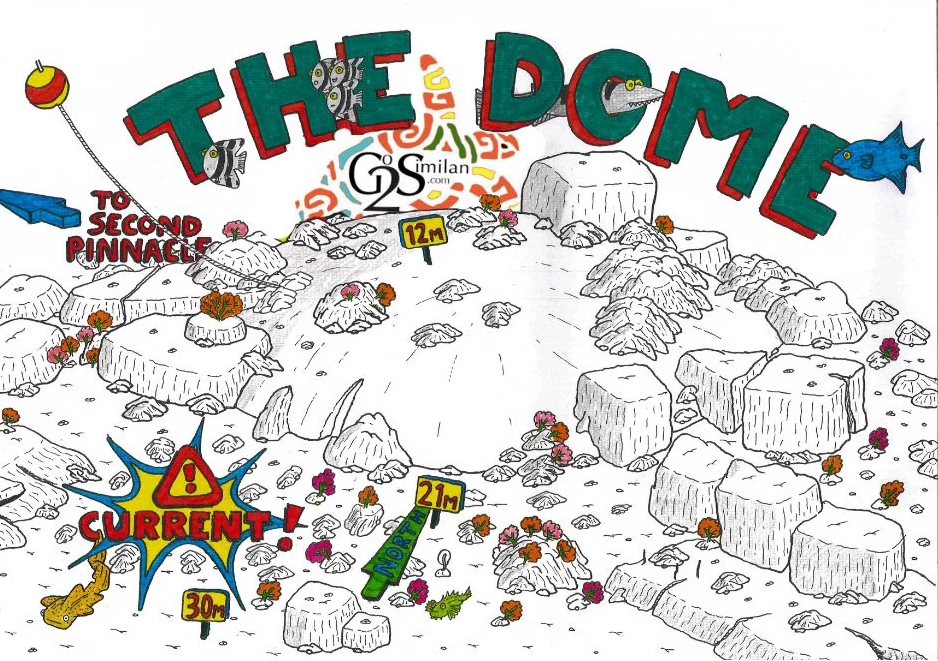
dive site: koh tachai pinnacle
SIMILAN Islands national park
| Dive Site Name | Koh Tachai Pinnacle |
| Also Known As | The Dome / Koh Tachai Dome / ‘The Dome of Doom’ (a nickname among guides reflecting the strong currents, not the site’s safety record) |
| Island / Area | Mu Ko Similan National Park, Koh Tachai — the northernmost island in the park. The Pinnacle is a submerged site located just south of the island itself, in open water with no shelter from the island. |
| GPS Latitude | 9.05802 |
| GPS Longitude | 97.81172 |
| Site Type | Submerged granite pinnacle (dome-shaped) surrounded by scattered boulders, with a second and third smaller pinnacle to the north across a sandy plain. Open-water site with no island shelter. |
| Access | Liveaboard primarily; day trips by speedboat from Khao Lak are also possible (approximately 1 hour 20 minutes by fast catamaran). Note: Koh Tachai island itself has been closed to land visitors since May 2016 due to environmental damage from overtourism — the Pinnacle dive site remains open. |
Depth and Conditions
| Minimum Depth | 10–12 m (top of the main dome, where the mooring/descent line is attached) |
| Maximum Depth | 30–35 m (sandy seabed surrounding the pinnacle and boulders) |
| Average Depth | 18–24 m, typically finishing the dive on top of the main pinnacle at around 15 m |
| Typical Visibility | 15–30 m. Visibility is generally good, though the nutrient-rich water that attracts the marine life can occasionally reduce it, particularly when current is running strongly. |
| Current | Often strong and a defining feature of the site. The open-water position means the Pinnacle is exposed to currents from any direction with no island to provide shelter. On strong days, divers shelter in the lee of the larger boulders. Currents bring the nutrients that drive the site’s exceptional marine life — a strong-current day is often the best day to dive it. |
| Water Temperature | 27–30°C throughout the season. |
| Best Season | Late October to mid-May, in line with the Mu Ko Similan National Park season. January to May offers the best chance of manta rays and whale sharks. |
| Best Time of Day | Morning, before the wind picks up and while the site is least crowded. Night dives are not conducted here — the currents and remote, exposed location make night diving unsafe at this site. |
Diver Suitability
| Minimum Certification | PADI Advanced Open Water Diver. This is one of the more demanding sites in the Similan/Surin area and is not appropriate for Open Water certified divers, regardless of dive count. |
| Recommended Experience | 40+ dives, including experience diving in moderate-to-strong current. Comfort with negative entries, descending quickly along a line in current, and maintaining position near boulders is essential. Good buoyancy and air consumption matter — there is little to hold onto in open water if you are working hard against current. |
| Suitable for Beginners? | No. The combination of open-water exposure, frequently strong and unpredictable current, depth, and remote location make this unsuitable for newly certified or inexperienced divers. This is one of the few sites in the region where we will decline to take divers who do not meet the experience guidelines, for their own safety. |
| Suitable for Advanced? | Yes — this is exactly the site Advanced certification exists for. Confident divers are rewarded with some of the best schooling-fish action in Thailand, dramatic boulder topography, and a realistic chance of mantas or whale sharks. Most divers who dive Koh Tachai rate it among their best dives in Thailand. |
| Snorkelling Viable? | No. The Pinnacle is a fully submerged open-water site with no shelter, no shallow snorkel zone, and exposure to current and surface swell. There is no snorkelling component to this site. Snorkelling may be possible along the reef nearby with appropriate surface dinghy support. |
Suitability Summary
Koh Tachai Pinnacle is an Advanced Open Water site and should not be attempted by less experienced divers. The open-water position, frequent strong currents, and depth combine to make this one of the more demanding dives in the Similan/Surin area — but for divers who meet the experience guidelines, it is consistently rated among the best dives in Thailand. Expect to be working with current rather than against it, to use the boulders for shelter when needed, and use a divemaster who knows the site. The reward for meeting these requirements is genuinely spectacular: massive schools of barracuda and trevally, dramatic granite topography, and a real chance of manta rays or a whale shark.
SITE DESCRIPTION – Koh Tachai Pinnacle
OVERVIEW — WHAT MAKES THIS SITE SPECIAL
Koh Tachai Pinnacle sits in open water just south of Koh Tachai, the northernmost island in Mu Ko Similan National Park and one of the most remote sites regularly dived from Khao Lak. Where most Similan sites are anchored against an island and benefit from at least some shelter, the Pinnacle stands alone — a submerged granite dome surrounded by scattered boulders, fully exposed to the open Andaman Sea. That exposure is precisely what makes it exceptional: currents sweeping across the site bring nutrient-rich water that supports one of the densest concentrations of schooling fish anywhere in Thailand.
Koh Tachai island itself has been closed to land tourism since 2016, after mass tourism caused significant ecological damage to its famous beach. The Pinnacle dive site, however, remains open, the marine life here has become noticeably healthier since the closure — fewer day-trip snorkel boats, less disturbance, and a site that feels genuinely wild. On a good day with strong current and big schools moving through, Koh Tachai Pinnacle competes seriously with Richelieu Rock for the title of best dive site in the region.
DIVE ROUTE / LAYOUT
The site is centred on a large dome-shaped granite boulder — the main pinnacle — with its summit at approximately 10–12 m, marked by a mooring or descent line. Smaller boulders are scattered around its base, with the sandy seabed beginning at 30–35 m. A second and third, smaller pinnacle lie to the north across a sandy plain at around 25 m, reachable as an extension of the dive for divers managing their NDLs carefully, when the current is running from South to North.
Descents are made via the line, and on days with strong current divers should be ready to descend promptly and use the boulders for shelter at the bottom. Once at depth, the dive typically explores the area around the main pinnacle — either clockwise or anticlockwise, at the divemaster’s discretion depending on current direction — working through channels between the larger boulders at 18–24 m. The dive concludes by ascending onto the top of the main pinnacle at around 15 m, where schooling fish and batfish often hold position in the current directly above the dome — making for one of the most memorable safety stops in Thai diving. Divers wanting to extend the dive and explore the northern pinnacles should watch their no-decompression limits closely, as there are fewer shallow refuge points on that side of the site.
HIGHLIGHTS & UNIQUE FEATURES
The defining feature of Koh Tachai Pinnacle is sheer scale of fish life moving through open water. Schools of chevron and giant barracuda form dense, swirling walls in the current; trevally — giant, bluefin, and other species — hunt through these schools; and fusiliers stream past in their thousands. Divers regularly describe feeling as though they are inside an aquarium, surrounded on all sides by moving fish.
The granite topography itself is dramatic and reminiscent of the Similan Islands’ famous boulder sites, but on a larger and more exposed scale: the dome-shaped main pinnacle, the labyrinth of swim-throughs and channels between boulders, and coral plateaus on the elevated boulder tops covered in hard and soft corals and gorgonian sea fans. Batfish frequently hold station in the current directly above the main pinnacle and will often hang around divers during the safety stop — an experience unique to this site. The combination of dramatic topography and overwhelming fish activity is what places Koh Tachai Pinnacle among Thailand’s very best dive sites.
Marine Life at Koh Tachai Pinnacle
REGULARLY SEEN SPECIES
- Fish: Large schools of chevron barracuda (Sphyraena putnamae) and giant barracuda (Sphyraena barracuda) are the signature sighting, often forming dense walls in the current. Giant trevally (Caranx ignobilis) and bluefin trevally (Caranx melampygus) hunt through the schools. Dense shoals of yellowback fusiliers (Caesio teres) and other fusilier species stream across the site continuously. Long-fin batfish (Platax teira) hold station above the main pinnacle, often approaching divers during the safety stop. Rainbow runners (Elagatis bipinnulata) and various mackerel and tuna species pass through in open water.
- Sharks / Rays: Blacktip reef sharks (Carcharhinus melanopterus) have been increasingly seen around the main and northern pinnacles in recent years — a positive sign following the 2016 closure of the island to land tourism. Leopard sharks (Stegostoma tigrinum) are occasionally found resting in sandy areas at depth. Manta rays (Mobula birostris) and whale sharks (Rhincodon typus) are realistic, though not guaranteed, encounters — most likely between January and May.
- Reef & Boulder Species: The coral plateaus on top of the boulders support a typical Andaman reef community — angelfish, groupers, sweetlips, and snapper species. Banded sea kraits (Laticauda colubrina) are occasionally seen at the surface or moving between rocks. Nudibranchs and other small invertebrates are present on the boulder surfaces, though the site’s reputation rests primarily on its open-water schooling action rather than its macro life.
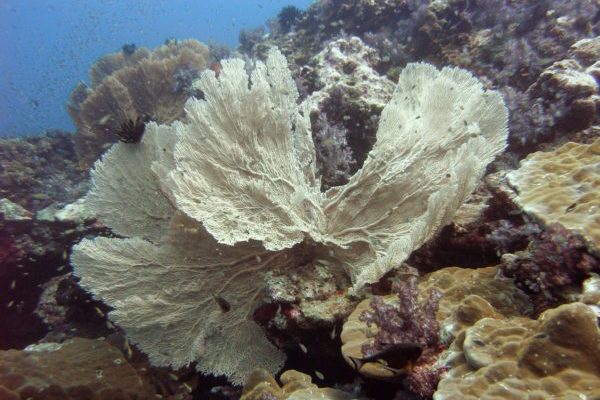
- Coral: Hard and soft corals cover the elevated coral plateaus on the boulder tops, with gorgonian sea fans and sponges on the deeper boulder faces and in the channels between rocks. The remoteness and reduced visitor numbers since 2016 have helped maintain healthy coral cover at this site relative to more heavily-dived locations.
SEASONAL / PELAGIC HIGHLIGHTS
Manta rays (Mobula birostris) and whale sharks (Rhincodon typus) are the headline seasonal draw at Koh Tachai Pinnacle, with both species most likely to be encountered between January and May. As with other open-water pinnacle sites in the region, neither species is guaranteed on any given dive — but the site’s nutrient-rich currents make it one of the better candidates in the area for these sightings.
The schooling fish activity — barracuda, trevally, and fusiliers — is the more reliable highlight and is at its most spectacular when current is running strongly. Divers should not be discouraged by a forecast of strong current at Koh Tachai: it is often the difference between a good dive and an unforgettable one.
PHOTOGRAPHY NOTES
Koh Tachai Pinnacle is a wide-angle site, first and foremost. The combination of dramatic granite topography and overwhelming numbers of schooling fish is best captured with a fisheye or wide rectilinear lens, shooting up towards the surface to silhouette the boulders and schools against the light. Position yourself below and to the side of a moving barracuda or trevally school and let it pass overhead for the most dramatic compositions — fighting current to chase a school rarely produces good images and wastes air.
On top of the main pinnacle, the batfish that often gather in the current provide an unusually calm and approachable subject after an otherwise high-energy dive — a useful opportunity to capture a more intimate portrait shot. Macro opportunities exist on the boulder tops and in sheltered channels but are secondary to the wide-angle action; photographers should prioritise positioning for the schools and treat any macro subjects encountered along the way as a bonus. Given the current, secure all camera accessories and avoid loose lanyards or strobe arms that could snag on boulders.
Koh Tachai Pinnacle FAQ’s
Is Koh Tachai Pinnacle suitable for beginner divers?
No. Koh Tachai Pinnacle is an Advanced Open Water site and is not recommended for beginners or newly certified divers under any circumstances. The site sits in open water with no real island shelter, currents are frequently strong and can change direction without warning, and the depth range (10–35 m) and remote location require confident buoyancy, good air management, and the ability to use boulders for shelter when conditions demand it. We require PADI Advanced Open Water certification (or equivalent) and recommend at least 40 logged dives, including experience in current, before including guests on this dive.
What marine life can I see at Koh Tachai Pinnacle?
The signature sighting is large schools of chevron and giant barracuda, often joined by giant and bluefin trevally hunting through the school, and dense shoals of fusiliers streaming across the site. Long-fin batfish frequently gather above the main pinnacle, especially during the safety stop. Blacktip reef sharks have become more common since the island’s 2016 closure to land tourism, and leopard sharks are occasionally found on the sand. Between January and May, manta rays and whale sharks are possible, though never guaranteed. The boulder tops also support a healthy reef community of angelfish, groupers, snapper, and soft corals and sea fans.
What is the best time of year to dive Koh Tachai Pinnacle
Koh Tachai is part of Mu Ko Similan National Park, which is open from late October to mid-May. Diving is possible throughout this season, but January to May is considered the best window for manta ray and whale shark encounters, when nutrient-rich currents are most active. The site can be dived on any day the park is open, and a forecast of strong current should not be seen as a reason to avoid it — strong current is often when the schooling fish activity is at its most spectacular. The park is fully closed from mid-May to mid-October during the south-west monsoon.
How deep is Koh Tachai Pinnacle?
The top of the main pinnacle, where the descent line is attached, sits at approximately 10–12 m. From there the site slopes down through scattered boulders to a sandy seabed at 30–35 m. Most of the dive takes place between 18 and 24 m, working around the boulders and through swim-throughs, before ascending to finish on top of the main pinnacle at around 15 m. A second and third pinnacle lie across a sandy plain to the north at approximately 25 m — an extension for divers with sufficient air and NDL margin. PADI Advanced Open Water certification (30 m limit) is required to dive this site safely.
Can I snorkel at Koh Tachai Pinnacle?
No. Koh Tachai Pinnacle is a fully submerged open-water dive site with no shallow snorkel zone, no shelter from current or swell, and a minimum depth of 10–12 m even at the shallowest point. There is no snorkelling component to this dive site. Note also that Koh Tachai island itself has been closed to land visitors since 2016, so there is no beach access either. Divers travelling with non-diving companions should be aware that Koh Tachai is a scuba-only destination with limited activities for snorkellers or those staying on the boat. Occasionally, snorkelling may be allowed on the nearby reef if dinghy support is available.
What current can I expect at Koh Tachai Pinnacle?
Current is a defining feature of this site and can be moderate to strong, arriving from any direction since the Pinnacle sits in open water with no real shelter from the island. The dive plan typically involves a prompt descent down the line and use of the larger boulders for shelter when needed. On dives where the current is very strong, this can result in a ‘human flag’ descent.
Rather than something to be avoided, strong current at Koh Tachai is often associated with the best fish activity — the nutrients it carries are what draw the large schools and pelagic visitors.
Divers must be confident with diving in current and descending a line in strong current.

Ann Christmas
PADI Course Director
Post Author