Christmas Point sits on the north-western tip of Similan Island 9, where the sheltered east side of the island gives way to open water and the character of the dive changes completely. A cluster of massive granite boulders — one pinnacle breaking the surface, the rest stacked below to 35–40 m — creates a landscape of canyons, crevices, and an arch swim-through: a passageway at around 24 m draped in soft corals and inhabited by giant sweetlips and groupers. Christmas tree worms (Spirobranchus giganteus) — brilliantly coloured spiral-plumed polychaetes — grow in exceptional density and colour variety across the boulder surfaces throughout the site, and are possibly the explanation for the site’s name. Napoleon wrasse, leopard sharks, golden gorgonian sea fans, ribbon eels, and the occasional passing manta complete a site that rewards every diver who enters the water prepared for its currents.

dive site: christmas point

Similan Island 9

Dive Site Name Christmas Point
Also Known As Sometimes grouped with North Point / Rocky Point as part of the north-western tip of Island 9, but Christmas Point is a distinct site with its own layout, and character.
Island / Area Similan Islands — Island No. 9 (Koh Bangu). North-western tip of the island, immediately south of North Point. The site faces north-west into open water and is the most current-exposed of the three Island 9 dive sites (the others being Three Trees / Breakfast Bend on the east and North Point at the northern tip).
GPS Latitude 8.681721
GPS Longitude 97.641110
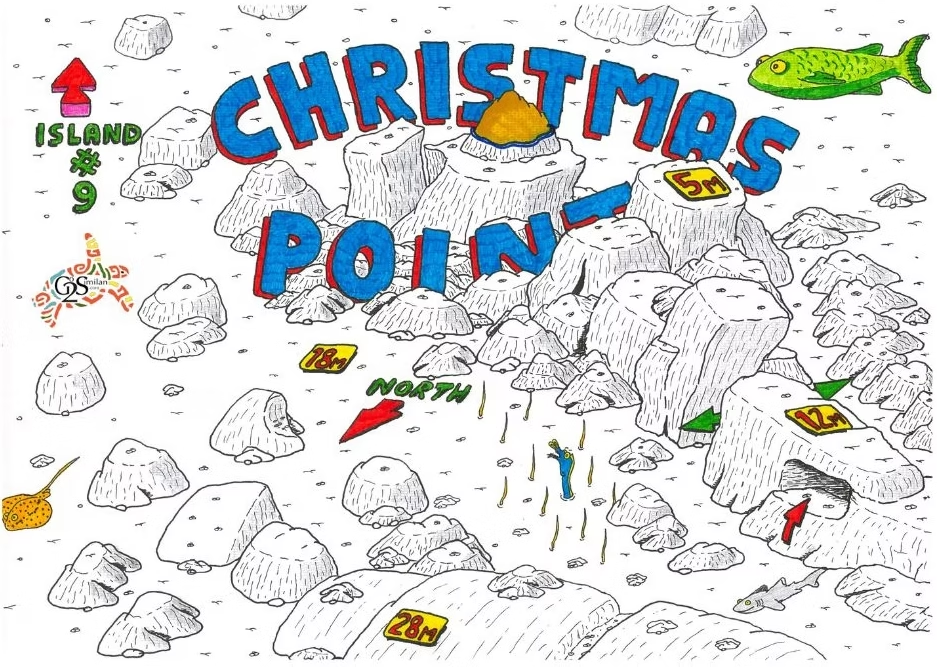
Site Type Granite boulder cluster on open sandy seabed. One pinnacle breaks the surface; the rest are submerged, stacked in groups to 35–40 m. Arch swim-through at approximately 24 m. North-west facing, exposed to open-water current.
Access Liveaboard and day trips. The north-western position makes this more exposed than the east-facing sites on Island 9 — surface conditions and current should be assessed before entry.   Because current is usually present, you jump from a point either to the East or West of the site (current depending) and drift onto the site.

Depth and Conditions

Minimum Depth Surface / 3 m (top of the visible pinnacle)
Maximum Depth 35–40 m (sandy seabed around the outermost and deepest boulders to the north-west)
Average Depth 20–28 m; the most productive section — the arch, sea fan crevices, and main boulder faces — is between 20 and 30 m
Typical Visibility 20–30 m. The north-west facing position generally maintains excellent open-water visibility.
Current Moderate to strong and the defining condition at this site. The north-west position fully exposes the boulders to open-water current with no island shelter. Current direction is variable; the standard approach is to follow the boulders and use them for shelter. On strong current days, divers work to stay sheltered by the larger boulders. The current also brings the marine life — Napoleon wrasse, trevally, and the occasional pelagic are most active when water is moving.
Water Temperature 27–30°C throughout the season.
Best Season October to May (Similan Islands National Park season). Best conditions are typically November–March.
Best Time of Day Morning — calmer surface conditions for entry and best light penetration into the boulder canyons and arch swim-through. Morning light filters dramatically through the boulder gaps above the arch at around 24 m.

Diver Suitability

Minimum Certification PADI Open Water Diver for the shallow boulder section (top of pinnacle to 15 m) with divemaster guidance. PADI Advanced Open Water recommended for the arch and the deeper boulder faces. The current exposure and open-water position make this a step above the sheltered east-side sites regardless of certification.
Recommended Experience 25–30+ dives for the shallow section; 40+ dives for the arch and deeper boulder zones. Prior experience diving in current and boulder topography valuable. Divers should be comfortable maintaining position near rock faces in moving water.
Suitable for Beginners? With significant caveats. The shallow section (3–15 m) is within Open Water limits, but the north-west facing position, variable current, and open-water exposure mean this is not a relaxed beginner environment in the way that Three Trees / Breakfast Bend is. Newly certified divers should only visit under close supervision on a calm, low-current day, staying on the shallow pinnacle rather than following the group to depth.
Suitable for Advanced? Yes, fully. The arch, gorgonian-draped deep boulder faces, open-water current action, Napoleon wrasse, potential pelagic passes, and leopard sharks on the sand all justify the Advanced certification.
Snorkelling Viable? No. The north-west facing open-water position, variable current, and exposure to swell make snorkelling unsafe and unrewarding. Snorkellers should be directed to the bay next to North Point.

Suitability Summary

Christmas Point is an intermediate-to-advanced site where the quality of the experience is directly proportional to the diver’s experience and the divemaster’s knowledge of conditions on the day. Open Water certified divers with 25+ dives can enjoy the upper pinnacle and shallower boulder crevices under supervision. Advanced certified divers with current experience get the full site: the arch swim-through, the golden gorgonian sea fans in the deep crevices, and the possibility of Napoleon wrasse, leopard sharks, and passing pelagics. Unlike Three Trees around the corner, this is not a site for nervous divers, newly certified guests, or snorkellers — the north-western exposure demands respect for conditions and a guide who knows the site.

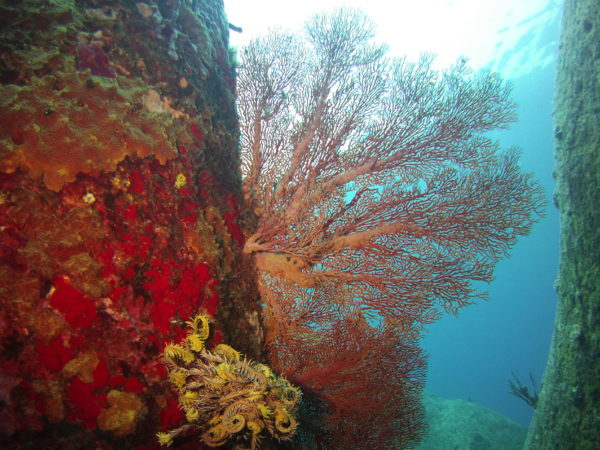
Gorgonian sea fan and soft coral on the granite boulder wall at West of Eden, Similan Island 7, Thailand

SITE DESCRIPTION

OVERVIEW — WHAT MAKES THIS SITE SPECIAL

Christmas Point occupies the north-western tip of Similan Island 9, where the long, sheltered reef of Three Trees / Breakfast Bend on the eastern side gives way to a completely different underwater world. One possible explanation for the site’s name is the Christmas tree worm (Spirobranchus giganteus) — a polychaete whose spiral feeding plumes resemble miniature Christmas trees and grow in dense clusters across the granite boulder surfaces throughout the site. Whether or not that is the true origin, the worms are undeniably a defining feature here and one of the most photographed macro subjects at any Similan Islands site.

The site’s centrepiece is a cluster of massive granite boulders, one of which breaks the surface. Underwater, the boulders create canyons, crevices, and the arch swim-through at around 24 m that are one of the most memorable features of diving in the northern Similan Islands. The arch frames a passageway wide enough for two divers side by side, walls and ceiling draped in orange and red soft corals, with giant sweetlips and large groupers stationed at the exit. Golden gorgonian sea fans span the crevices between boulders throughout the deeper sections. The open north-western exposure brings strong current on the right days, and with current comes life: Napoleon wrasse, giant trevally, and the occasional pelagic visitor circling the boulders in the blue.

DIVE ROUTE / LAYOUT

Divers descend and drift onto the site and head down and north-west along the boulder faces, dropping to 20–25 m where the architecture becomes more complex: canyons, overhangs draped in soft coral, and crevices sheltering ribbon eels and dancing Durban shrimps. At around 24 m the arch appears — a natural granite passageway approached from the east and exiting west into open water. Groupers and giant sweetlips are almost always present inside; sea fans frame the opening on both sides. Experienced divers can continue north-west to the deeper boulders at 30–40 m, where leopard sharks rest on the sandy floor and whitetip reef sharks cruise between the rock bases, but usually NDL restrictions mean that you are shallowing up after this.

The ascent follows the boulder system back towards the island, rising through the 15–20 m zone where Christmas tree worms are most abundant on the rock surfaces. The shallow hard coral garden at 5–10 m makes for a rewarding safety stop. Groups on stronger-current days may drift north and finish closer to North Point — a natural extension if conditions allow.

HIGHLIGHTS & UNIQUE FEATURES

The arch swim-through at around 24 m is the defining feature of Christmas Point and one of the most celebrated single underwater formations in the Similan Islands. Large enough for two divers side by side, interior surfaces covered in soft corals, and giant sweetlips and groupers almost always stationed at the western exit. Drifting through on a gentle current and emerging into open blue water flanked by those fish is an experience divers describe for years afterwards.

Christmas tree worms (Spirobranchus giganteus) are found here in exceptional density and colour variety — vivid yellows, electric blues, purples, and reds growing in tight clusters from the granite boulder surfaces. They are found across the Andaman Sea, but their profusion and colour variety here as exceptional relative to other Similan sites. They retract instantly when approached but re-emerge within seconds: approach slowly, pre-focus, and wait.

The golden gorgonian sea fans in the boulder crevices at 25–35 m are among the largest in the Similan Islands, some spanning more than 1.5 m across. Napoleon wrasse (Cheilinus undulatus) are reliably present here in higher frequency than at most Similan sites — their size, curiosity, and tendency to approach divers make them one of the most impressive encounters the site delivers.
Marine Life

REGULARLY SEEN SPECIES

  • Christmas tree worms (Spirobranchus giganteus): found in dense, multi-coloured clusters across boulder surfaces throughout the site, from the shallows to 30 m depth. Electric blue, vivid yellow, purple, and red colour forms all present. The density and variety of colour forms here is noted by multiple experienced guides as exceptional relative to other Similan sites. One of the most photographed macro subjects in the archipelago.
  • Large fish: Napoleon wrasse (Cheilinus undulatus) — reliably present and unusually approachable, often curious enough to follow divers through the boulder passages. Giant trevally (Caranx ignobilis) and bluefin trevally (Caranx melampygus) patrolling the open water around the boulders. Great barracuda (Sphyraena barracuda) and yellowtail barracuda (Sphyraena flavicauda) in loose aggregations. Humphead / bumphead parrotfish (Bolbometopon muricatum) occasionally encountered in the deeper boulder sections.
  • Arch & boulder residents: Giant sweetlips (Plectorhinchus obscurus) and large groupers (Epinephelus spp.) stationed at the arch exit. Yellow-banded sweetlips (Plectorhinchus lineatus) and other sweetlips species throughout the boulder crevices. Red fire gobies (Nemateleotris magnifica) at crevice entrances. Schools of yellow snapper (Lutjanus kasmira) around the larger boulder faces. Clown triggerfish (Balistoides conspicillum) on the boulder surfaces.
  • Sharks & rays: Whitetip reef sharks (Triaenodon obesus) resting on sand between boulders at depth. Leopard sharks (Stegostoma tigrinum) on the sandy plain at 30–40 m. Blacktip reef sharks (Carcharhinus melanopterus) in the mid-water. Eagle rays (Aetobatus narinari) occasionally in open water off the north-western boulder face. Hawksbill turtles (Eretmochelys imbricata) in the shallower boulder sections throughout the season.
  • Critters & macro: Ribbon eels (Rhinomuraena quaesita) in sand–boulder interface crevices. Dancing Durban shrimps (Rhynchocinetes durbanensis) in groups in shaded crevices. Pipefish (Syngnathidae) in small cracks in the rock. Frogfish (Antennarius spp.) camouflaged against encrusted boulder surfaces — check every irregular surface carefully. Nudibranchs (Chromodoris spp. and others) throughout. Giant moray eels (Gymnothorax javanicus) in deep crevices.
  • Coral: Soft corals (Dendronephthya spp.) draped inside the arch and on the deeper boulder faces. Golden gorgonian sea fans (Subergorgia spp.) in inter-boulder channels, some exceeding 1.5 m across. Sea whips (Junceella spp.) in current-exposed positions. Shallow hard coral garden (staghorn Acropora cervicornis, pore coral Porites lobata) on the upper pinnacle at 5–10 m. Christmas tree worms embedded throughout the hard coral zone.

SEASONAL / PELAGIC HIGHLIGHTS

Christmas Point is not a dedicated pelagic site in the manner of Koh Tachai or Richelieu Rock, but its north-western exposure means open-water species pass through unpredictably. Manta rays (Mobula birostris) are occasionally seen in the open water off the boulder face, particularly between November and March.  Dogtooth tuna (Gymnosarda unicolor) and rainbow runners (Elagatis bipinnulata) appear in the blue around the boulders on strong-current days.

The Napoleon wrasse at Christmas Point are notable for their consistency and approachability across seasons — this species has declined at many Similan sites due to fishing pressure outside the park, making Christmas Point one of the more reliable locations in the archipelago for an encounter with a large, fully grown individual.

PHOTOGRAPHY NOTES

Christmas Point offers exceptional opportunities at both ends of the focal length spectrum. The arch swim-through is the priority wide-angle subject: approach from the east, position at the entrance looking through, and expose for the ambient light in the exit while using a strobe or video light to illuminate the soft corals on the arch walls. A fisheye with a dome port captures the full sweep; include the groupers or sweetlips at the exit for scale and drama.

The golden gorgonian sea fans in the inter-boulder crevices are another wide-angle priority — shoot across the fan face with a diver small in the background and the current-feeding polyps extended. Most are fully extended in moderate current, so a mid-current day produces better sea fan shots than flat calm.

For macro, Christmas tree worms are the signature subject and should be prioritised early in the dive. A 60 mm or 100 mm macro lens at f/16–22 with twin strobes positioned to the sides eliminates backscatter and brings out the colour. Approach extremely slowly — they retract at the slightest vibration — frame while retracted, prefocusing at the empty hole, and wait. Re-emergence takes 10–30 seconds. The dancing Durban shrimps in the crevices benefit from a snooted light to separate them from the dark background.

Christmas Point FAQs

With significant conditions. Christmas Point is not beginner-friendly in the way that Three Trees / Breakfast Bend on the east side of Island 9 is. The north-west facing position exposes divers to open-water current, the most rewarding sections are at 20–30 m, and the boulder topography is complex. Open Water certified divers with 25+ logged dives can dive the upper pinnacle section (3–15 m) under close divemaster supervision on a calm, low-current day. They will see Christmas tree worms, reef fish, and the shallow hard coral garden, but will not reach the arch, the deep gorgonian crevices, or the sandy plain. For the complete Christmas Point experience, Advanced Open Water certification and experience in current are the right starting point.

Christmas tree worms (Spirobranchus giganteus) are polychaete worms that live embedded in hard coral, extending spiral feeding plumes that resemble tiny, brilliantly decorated Christmas trees. They are found across the Andaman Sea, but the density and colour variety at this site — electric blue, vivid yellow, purple, red — is noted by multiple experienced guides as exceptional. One widely cited explanation for the site’s name is this profusion of worms, though the true origin has not been confirmed from local sources and should be verified before being stated as fact. Regardless, the worms are a genuine highlight: they retract instantly when disturbed and re-emerge within seconds. Approach slowly, pre-focus, and wait. Many divers take their best Christmas tree worm photographs here.

The signature encounters are the arch swim-through at around 24 m with its resident giant sweetlips and groupers, Napoleon wrasse present with unusual regularity and often closely approaching divers, Christmas tree worms in dense colourful clusters across the boulder surfaces, and leopard sharks on the sand at 30–40 m. Whitetip and blacktip reef sharks cruise between the boulder bases. Golden gorgonian sea fans span the inter-boulder crevices at depth. In crevices: ribbon eels, dancing Durban shrimps, frogfish, pipefish, and giant moray eels. In open water: giant and bluefin trevally, great barracuda, and the occasional eagle ray. Hawksbill turtles are seen throughout the season in the shallower boulder sections.

The boulder system extends to 35–40 m on the sandy seabed. The most productive diving is between 20 and 30 m. The arch swim-through is at approximately 24 m — a natural granite passageway large enough for two divers side by side, with soft corals lining the interior and giant sweetlips almost always present at the exit. It is reached by swimming north-west from the island along the boulder faces; your guide will lead you directly to it. Advanced Open Water certification is required for the arch and main boulder sections. Open Water certified divers access the upper area only.

No. Christmas Point faces north-west into open water, is exposed to current, and has no sheltered bay or shallow protected zone. The main features are at 20–40 m and require scuba. If you are visiting Island 9 with non-diving or snorkelling companions, they should go to Three Trees / Breakfast Bend on the sheltered eastern side of the island or to the bay close to North Point while the diving group enters at Christmas Point.

Current at Christmas Point is moderate to strong and varies with season, time of day, and tidal state. The north-western position fully exposes the site to open-water current with no real shelter. On most days current runs broadly north-westerly along the boulder faces; on strong days it accelerates through the inter-boulder channels. Divers follow the boulder system and use the rocks for shelter rather than crossing open water in strong current. Stay close to the boulders, avoid ascending into mid-water if conditions have strengthened, and follow the guide’s direction on exit. Strong-current days are often the best for large fish activity — Napoleon wrasse and trevally are noticeably more active when water is moving well.

Ann Christmas - Padi Course Director

Ann Christmas
PADI Course Director

Post Author