
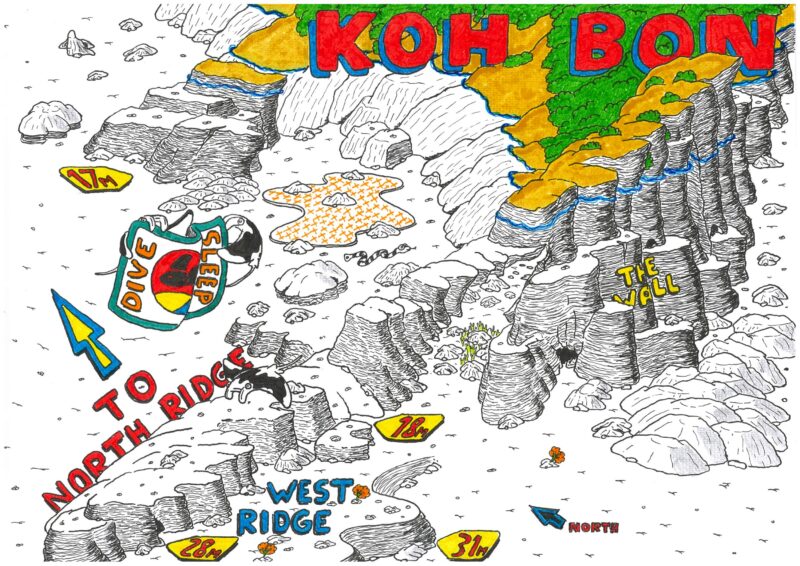
Koh Bon West Ridge

Koh Bon is Thailand’s best site for diving with manta rays — a granite island set apart from the main Similan group where two distinct dive sites serve different levels of diver simultaneously. The West Ridge, draped in soft corals and dotted with cleaning stations, draws oceanic manta rays reliably from November to April and is accessible to most certified divers. The North Ridge has beautiful hard corals and is often dived as the second site of the day. Almost every liveaboard in Thailand makes Koh Bon a scheduled stop. For divers who want to swim with mantas, this is the first place to look.
dive site: koh Bon

SIMILAN Islands national park

Dive Site Name Koh Bon (West Ridge & North Ridge)
Also Known As Koh Bon Ridge / Koh Bon West Ridge (for the main dive); Koh Bon North Ridge. The island is easily recognised by a circular natural arch visible in the granite cliff face above the waterline.
Island / Area Mu Ko Similan National Park. Koh Bon is an isolated limestone island approximately 20 km northwest of the main Similan Islands group, in the open Andaman Sea. The main dive sites are on the west and north ridges on the west side of the island.
GPS Latitude 9.0300 (approximate — confirm against vessel chartplotter)
GPS Longitude 97.7800 (approximate — confirm against vessel chartplotter)
Site Type West Ridge: rocky limestone ridge running west from the island, with soft-coral walls dropping to 40 m.
Access Liveaboard and day trip by speedboat from Khao Lak. Koh Bon is a regular stop on most Thailand liveaboard itineraries. Day trips are operated most days — you can find the current diving day trip schedule here.

Depth and Conditions

Minimum Depth 5 m – a sheltered bay on the east side of the ridge provides a shallow safety-stop zone and snorkeling site
Maximum Depth 35–40 m (base of the west-facing wall and the deep point of the ridge)
Average Depth 15–22 m, where the wall meets the ridge
Typical Visibility 20–30 m. Nutrient-rich water associated with manta activity can temporarily reduce visibility to 15 m on the best manta days — a productive trade-off experienced divers learn to welcome.
Current Mild to moderate on most days, occasionally strong on the outer west-facing wall. Current funnels along the ridge and can pick up suddenly around the western tip — the point where manta encounters most frequently occur. Be prepared to hold position at the ridge edge while watching the blue.
Water Temperature 28–30°C throughout the season.
Best Season November to April for manta rays; diving is possible throughout the park season (October to May). Manta activity peaks between December and March.
Best Time of Day Morning for the calmest conditions and clearest water. Late afternoon and sunset dives, when the light drops into the western-facing wall, are exceptional for photography and are often scheduled on liveaboards moored overnight.

Diver Suitability

Minimum Certification

PADI Open Water Diver for the top sections of the West Ridge and Koh Bon bay. PADI Advanced Open Water required for the deeper west-facing wall sections of the West Ridge and North Ridge(18–40 m).

Recommended Experience

West Ridge: 20+ dives, comfortable in mild current. North Ridge is deeper and requires Advanced certification to go down to the ridge, but Open Water divers can dive the shallower reef section. Less experienced divers can comfortably dive in Koh Bon bay which has low current and a typical depth of 15m.

Suitable for Beginners?

Partially. The bay and the top of the West Ridge, in its shallower sections between 5 and 18 m, is accessible to newly certified Open Water divers under close supervision. The section of the west ridge where mantas are seen most reliably is 15–22 m, within Open Water depth limits on a good current day. Beginners cannot access the deeper wall or the deeper section of North Ridge.

Suitable for Advanced?

Yes, fully — the deeper ridge wall, the open-water manta encounters in the blue, and the North Ridge are all Advanced-level experiences. Most experienced divers regard Koh Bon as one of the most complete dive sites in Thailand.

Snorkelling Viable?

Not at the main dive sites. The ridge begins at 3–5 m but the western side is exposed and the key marine life and manta activity are at diving depth. The sheltered bay on the south side and the shallows at the top of the North Ridge are calmer and shallow enough for snorkelling, and can result in black-tip sightings if lucky.

Suitability Summary

Koh Bon is one of the most accessible sites in the Similan/Surin area for a wide range of certified divers, and the only site in the group where an Open Water diver genuinely has a realistic chance of encountering manta rays. The West Ridge, at 5–35 m, covers most certification levels, with the shallower sections suitable for recently certified divers and the deep wall and open-water manta watching suited to Advanced and above.

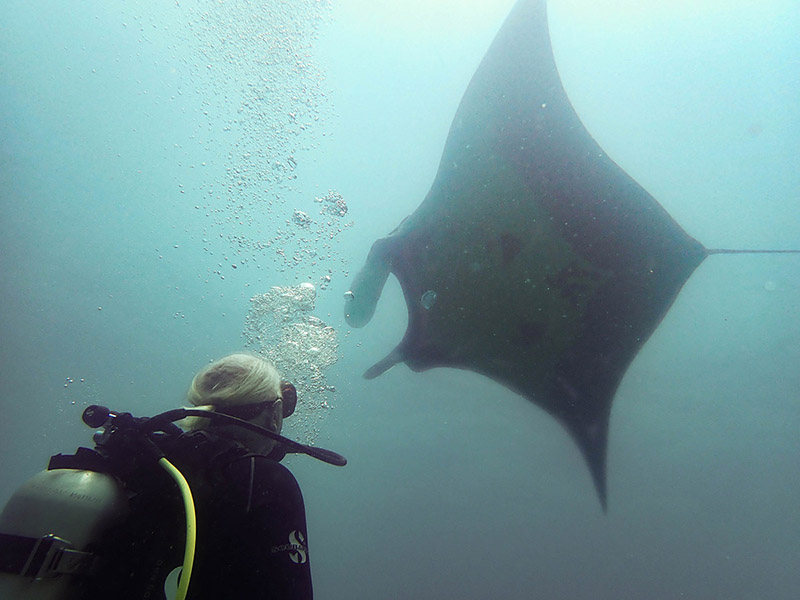
Manta ray and diver

SITE DESCRIPTION – Koh Bon

OVERVIEW — WHAT MAKES THIS SITE SPECIAL

Koh Bon sits approximately 20 km northwest of the main Similan Islands group, isolated in open water and different in character from its southern neighbours. The island is immediately recognisable by the circular natural arch punched through its granite cliff face above the waterline — a landmark visible from the approach by boat.

The West Ridge is Thailand’s most reliable manta ray site. Oceanic manta rays (Mobula birostris) visit the along the ridge’s soft-coral wall throughout the season from November to April, with peak activity between December and March.

The North Ridge has beautiful hard corals and is often dived as the second site of the day.

DIVE ROUTE / LAYOUT

Boats moor in the sheltered bay on the east side of the western ridge. Divers are usually dropped by dinghy at ‘the waterfall’,  descend and head west along the south wall of the ridge, which drops steeply to around 35 m. The wall is encrusted with soft corals, zigzag clams (Ctenoides ales), and sea fans; moray eels occupy crevices throughout, often attended by cleaner shrimps. Octopus and cuttlefish are common along this section.

As the route rounds the western tip of the ridge, the wall becomes fully exposed to open water and current strengthens. This is the primary manta zone: divers hold position at the ridge edge, or hover in the blue slightly off the wall, and watch for mantas approaching from the south or circling in the mid-water. When a manta is present, the protocol is to remain still and let the animal approach rather than pursuing it — mantas have been observed deliberately positioning themselves over diver bubble streams, apparently enjoying the sensation.

The dive can then continue over the ridge, shallowing up on the north side, or if current is too strong from the north, you turn around and ascend along the ridge back towards the bay, finishing in the shallower sections at 5–10 m, where the soft corals and fish life remain dense and the safety stop is genuinely enjoyable.

HIGHLIGHTS & UNIQUE FEATURES 

The manta rays on the West Ridge are the most dependable in Thailand. Unlike open-ocean manta encounters at sites like Richelieu Rock or Koh Tachai — where a manta passes through  — Koh Bon seems to bring mantas to a predictable location where they slow down and circle.  There are many accounts describing Koh Bon as a cleaning station, but I have never seen mantas being cleaned.  I have seen many mantas, singly and in gatherings of 4-8, but have never seen cleaning station behaviour.

You can regularly find Octopus (octopus cyanea) here and in many cases they are not phased by diver presence.  They can be seen hunting for crustaceans under the rocks with peacock grouper (Cephalopholis argus) waiting in the wings for scraps. You can check out my you-tube video of an octopus hunting at Koh Bon.

Marine Life at Koh Bon West Ridge

  • Rays / Sharks: Oceanic manta rays (Mobula birostris) along the ridge and in open water off the western tip — the primary reason most divers visit this site. Leopard sharks (Stegostoma tigrinum) rest on the sand at depth around the base of the ridge. Whitetip reef sharks (Triaenodon obesus) cruise the deeper sections. Blacktip reef sharks (Carcharhinus melanopterus) are regularly sighted in open water off the ridge. Eagle rays (Aetobatus narinari) and marbled rays (Taeniurops meyeni) are occasionally seen along the deeper wall.
  • Fish: Dense schools of sweetlips (Plectorhinchus spp.) and five-line snappers (Lutjanus quinquelineatus) are a consistent feature at around 15–20 m. Bluefin trevally (Caranx melampygus) and giant trevally (Caranx ignobilis) hunt in the mid-water.  Banded sea kraits (Laticauda colubrina) are regularly seen at the surface between dives and swimming between rocks. Barracuda (Sphyraena spp.) in loose aggregations.
  • Critters:  Moray eels (Gymnothorax spp.) with cleaner shrimps (Lysmata amboinensis) throughout the ridge. Octopus (Octopus cyanea) are common and occasionally cuttlefish (Sepia spp.) along the wall. Nudibranchs (Chromodoris spp. and others) on encrusted surfaces. Maldives sponge snail (Coriocella hibyae) is common and visible at all depths on the rocks.
  • Coral: Soft corals (Dendronephthya spp.) in purple, pink, and red on the ridge wall. Zigzag clams (Ctenoides ales), so-called for their electric-blue flickering mantle, are scattered throughout. Gorgonian sea fans on the deeper sections. Hard coral coverage in the shallower bay areas on both sides of the ridge.

SEASONAL / PELAGIC HIGHLIGHTS

Oceanic manta rays (Mobula birostris) are the defining seasonal draw at Koh Bon, and are fairly reliably present from November to April and peaking between December and March. These large oceanic mantas return to the same cleaning stations year after year. Regular visitors across multiple seasons have reported recognising individual animals by their distinctive spot patterns on the underside of the disc.  While reliable over the season, there is no certainty of seeing them on any particular day or week.

Whale sharks (Rhincodon typus) are an occasional bonus encounter, most likely January to April. Banded sea kraits (Laticauda colubrina) are present throughout the season and are reliably seen at Koh Bon in higher numbers than at most Similan sites — they swim to the  surface between dives and are commonly spotted swimming between rocks.

PHOTOGRAPHY NOTES

Koh Bon is a site that genuinely demands both wide-angle and macro setups across different dives. If you are only diving once, go wide-angle: the manta rays (if present), the schooling sweetlips, and the soft-coral wall are all wide-angle subjects. The classic Koh Bon shot — a manta ray hovering over the soft-coral ridge with a diver small in the frame — requires a fisheye or ultrawide and a steady, patient approach. Do not approach the manta from above or swim towards it; position yourself on the ridge and let it come to you.