
Three Trees — the most rewarding section of the long reef known as Breakfast Bend — is one of the most accessible, richest, and most underrated dive sites in the Similan Islands. A gently sloping coral reef on the sheltered east side of Island 9 transitions into a dramatic boulder formation at depth and a whip-coral garden that dive guides describe as other-worldly. Suitable for all levels of certified diver, and one of the best snorkelling sites in the group.
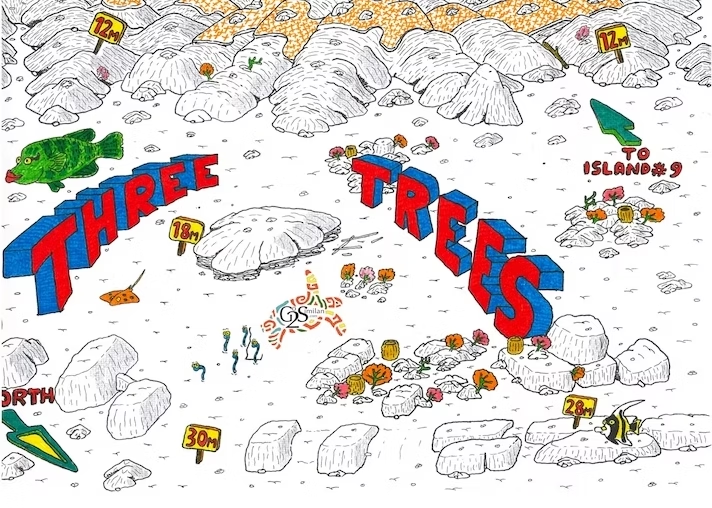
dive site: THREE TREES
SIMILAN Island 9
| Dive Site Name | Three Trees (Breakfast Bend) |
| Also Known As | Breakfast Bend (the full reef system of which Three Trees is the headline section); Batfish Bend (used by some operators for the batfish-rich northern end). The three distinctive tall, pale-trunked trees visible on the island’s hillside give the site its working name and serve as the primary surface navigation landmark for divers. |
| Island / Area | Similan Islands — Island No. 9 (Koh Bangu). The dive site runs along the east and north-east side of the island. The reef system has three informal sections: Breakfast Bend in the south, Three Trees in the middle (the prime dive section), and a transition to North Point at the northern end on strong-current days. |
| GPS Latitude | 8.680706 |
| GPS Longitude | 97.651842 |
| Site Type | Gently sloping hard coral reef (shallow section, 5–20 m), transitioning to sandy slope with scattered coral bommies and pinnacles (20–30 m), with a cluster of large granite boulders at 24–30 m and a distinctive whip-coral garden running north. East-facing, sheltered aspect. |
| Access | Day trip and liveaboard. The east-facing position makes this a reliable calm-water alternative on days when south-west swell makes west-facing sites (Elephant Head Rock, West of Eden) rougher. |
Depth and Conditions
| Minimum Depth | 5 m (top of the shallow reef; snorkel-accessible) |
| Maximum Depth | 30–35 m (base of the granite boulder cluster and the sandy plain at depth) |
| Average Depth | 10–20 m for most divers. Experienced divers extend to 24–30 m to explore the Three Trees boulder formation. |
| Typical Visibility | 20–30 m. As an east-facing site with a gently sloping profile, visibility is consistently good and often better than the more exposed west-facing sites on rougher days. |
| Current | Mild to moderate, typically running south to north along the reef. Current strength determines the dive plan: on calm days divers can choose their entry point and explore freely; on moderate days the drift south-to-north is pleasant; on strong-current days the dive may run as far as North Point. |
| Water Temperature | 27–30°C throughout the season. |
| Best Season | October to May (Similan Islands National Park season). The east-facing aspect also makes this site particularly valuable later in the season (March–May) when afternoon south-westerlies begin to affect the exposed western sites. |
| Best Time of Day | Sunrise and early morning for the calmest conditions and best light on the hard coral garden. Sunset dives are exceptional — bluefin trevally hunt the reef actively in the late afternoon, and the whip coral garden in the north catches the low-angled light dramatically. |
Diver Suitability
| Minimum Certification | PADI Open Water Diver. The entire shallow reef section (5–20 m) is well within Open Water limits and is genuinely suitable for newly certified divers. The boulder section at 24–30 m requires PADI Advanced Open Water. |
| Recommended Experience | Shallow reef: any level. Boulder/deep section: 20+ dives, Advanced certification, comfortable buoyancy on sand. |
| Suitable for Beginners? | Yes. The sheltered east-facing reef, gentle slope, manageable current along the reef, and consistent 20–25 m visibility make this ideal for Open Water divers. Turtles and many of the angelfish species are in the shallowest section, so beginners do not miss the headline species by staying shallow. |
| Suitable for Advanced? | Yes, fully. The boulder cluster at 24–30 m and the deeper sand plain with garden eels and leopard sharks justify the Advanced certification, and the sheer length and species diversity of the site means experienced divers rarely feel they have seen everything in a single dive. |
| Snorkelling Viable? | Yes — the shallow, east-facing reef at 5–10 m is accessible. Hard coral coverage is healthy in the shallow section, fish life is dense, and the sheltered bay to the north provides calm surface conditions. Snorkellers will encounter angelfish, parrotfish, turtles, pufferfish, and trumpetfish in the top reef zone. Current can be a factor, and the suitability needs to be evaluated on the day. |
Suitability Summary
Three Trees / Breakfast Bend is one of the most broadly accessible dive sites covered in this guide series. A newly certified Open Water diver and an experienced Advanced diver can enter the water at the same point, dive different sections of the same reef, and both surface having had an outstanding experience. The shallow coral garden, exceptional angelfish diversity, and the high chance of seeing turtles are accessible to all levels; the boulder cluster, deep sand plain, and strong-current drift to North Point are great for those with more experience.
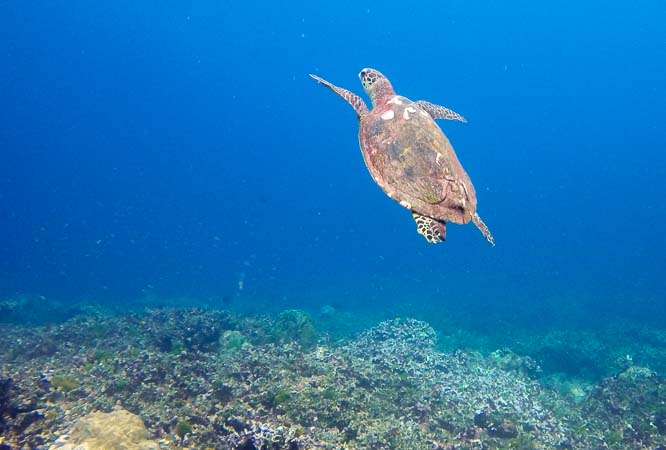
SITE DESCRIPTION – Three Trees (Breakfast Bend)
OVERVIEW — WHAT MAKES THIS SITE SPECIAL
Breakfast Bend takes its name from the early years of Similan liveaboard diving, when boats would anchor on the sheltered east side of Island 9 overnight and divers would make their first dive of the morning here over breakfast. The name Three Trees refers to three tall, pale-trunked trees standing conspicuously above the island’s hillside vegetation — visible from the boat and used as a surface bearing to find the most productive section of the dive.
What makes this site exceptional is a combination of consistent accessibility and genuine species richness at all depths. Green and hawksbill turtles are seen with unusual regularity in the shallows — this is one of the most consistent turtle sites in the Similan Islands, with encounters on the majority of dives throughout the season rather than occasional sightings. Deeper, the reef transitions to a boulder formation at 24–30 m covered in soft corals and sea fans, and a whip coral garden running north that experienced guides from multiple liveaboard operators have independently described as unlike anything else in the Similan Islands.
DIVE ROUTE / LAYOUT
The dive plan at Three Trees is determined by current direction and strength on the day, making the pre-dive briefing especially important. In mild-to-no current, divers descend at the Three Trees section — using the three white-trunked trees as a surface bearing — and the dive begins in the mid-reef zone at 10–15 m before dropping out to the boulder cluster at 24–30 m. After exploring the boulders and the sandy plain at depth, divers ascend back onto the reef and head north through the whip coral garden, finishing in the shallows (5–10 m) where green sea turtles (Chelonia mydas) and hawksbill turtles (Eretmochelys imbricata) are regularly found. The safety stop is taken on the top of the reef.
In moderate-to-strong north-running current, the dive is run as a drift: divers enter further south on the Breakfast Bend section and let the current carry them north through the reef, passing the bommies and coral pinnacles on the slope at 10–20 m, out to the boulders at depth if NDLs allow, and then drifting further north through the whip coral garden. On strong-current days the drift can continue past Three Trees entirely and finish at North Point — a completely different site with boulder formations and channels that is well worth reaching if conditions carry you there.
HIGHLIGHTS & UNIQUE FEATURES
Green and hawksbill turtles grazing the reef in the shallows are the signature encounter at Three Trees. Both species are seen regularly throughout the season, and the frequency of sightings here is higher than at any other site in the Similan Islands. Turtles are particularly active on the coral in the early morning and in the shallowest sections of the reef at 5–10 m. For divers and snorkellers who have this encounter as a priority, Three Trees is the first site to visit.
The angelfish diversity here is exceptional by any standard. It is not unusual to encounter six or more angelfish species on a single dive: emperor angelfish (Pomacanthus imperator), regal angelfish (Pygoplites diacanthus), blue-ringed angelfish (Pomacanthus annularis), Koran angelfish (Pomacanthus semicirculatus), masked angelfish, and pygmy angelfish (Centropyge spp.) are all present.
The whip coral garden in the northern section is one of the most visually unusual environments in the Similan Islands. Sea whips (Junceella spp. and Ellisella spp.) grow here in a density and uniformity that creates a forest-like appearance underwater, particularly striking at first light or at sunset when the angled light catches the structure. It is a wide-angle photography subject that is effectively unique to this site.
Marine Life at Three Trees (Breakfast Bend)
REGULARLY SEEN SPECIES
- Turtles: Hawksbill turtles (Eretmochelys imbricata) and green turtles (Chelonia mydas) are both regularly seen grazing the coral in the shallows throughout the season. Three Trees is the most consistent turtle site in the Similan Islands. Encounters are most frequent at 5–10 m in the early morning and on the upper reef section during the safety stop.
- Fish — reef: Exceptional angelfish diversity: emperor angelfish (Pomacanthus imperator), regal angelfish (Pygoplites diacanthus), blue-ringed angelfish (Pomacanthus annularis), Koran angelfish (Pomacanthus semicirculatus), and pygmy angelfish (Centropyge spp.) regularly seen on a single dive. Long-fin batfish (Platax teira) in schools, particularly prominent at the northern end. Red-tooth triggerfish (Odonus niger) in mid-water aggregations. Clown triggerfish (Balistoides conspicillum) on the bommies. Raccoon butterflyfish (Chaetodon lunula), Moorish idols (Zanclus cornutus), and bannerfish (Heniochus spp.) throughout. Trumpetfish (Aulostomus chinensis), pufferfish (Arothron spp.), porcupinefish (Diodon spp.), and boxfish (Ostracion spp.) on the reef. Napoleon wrasse (Cheilinus undulatus) sighted regularly.
- Fish — sand and deep: Spotted garden eels (Heteroconger hassi) at the deepest sandy areas at 25–30 m — move slowly and stay low to approach. Ribbon eel (Rhinomuraena quaesita) at the sand–boulder interface. Bluefin trevally (Caranx melampygus) actively hunting the reef in late afternoon. Yellowtail barracuda (Sphyraena flavicauda) in loose aggregations. Milkfish (Chanos chanos) in the shallowest sections, especially early morning. Yellow margin trigger fish (Pseudobalistes flavimarginatus) nest in the sand below the reef, you should swim low and take care when negotiating the transition from boulders to the reef during nesting season.
- Sharks / Rays: Leopard sharks (Stegostoma tigrinum) rest on the sandy plain at depth around the boulder cluster — particularly worth looking for at 24–30 m. Whitetip reef sharks (Triaenodon obesus) along the deeper reef edge. Kuhl’s stingray (Neotrygon kuhlii) on sandy patches.
- Specialist species: The Andaman foxface / magnificent rabbitfish (Siganus magnificus) — a strikingly patterned species with a black-and-white banded head and vivid yellow-and-white body, in the shallowest section of the reef to the north, swimming in pairs. Unusual and worth looking for on the shallow north reef, but not a guaranteed encounter.
- Critters & macro: Lionfish (Pterois volitans) in shaded sections. Longnose filefish (Oxymonacanthus longirostris) in pairs on coral. Nudibranchs (Chromodoris spp. and others) on the bommies. Rare gobies (Amblyeleotris spp.) at burrow entrances in the deep sand. Banded sea kraits (Laticauda colubrina) seen at the surface. Glassfish (Ambassis spp.) in dense schools around coral formations in the shallows.
- Coral: Healthy hard coral garden in the shallow section: staghorn (Acropora cervicornis), finger coral (Acropora spp.), brain coral (Platygyra spp.), pore coral (Porites lobata), and anemones with resident clownfish. Soft corals in blue, yellow, pink, and purple on the bommies and boulder surfaces at depth. Whip coral garden (Junceella spp. and Ellisella spp.) in the northern section.
SEASONAL / PELAGIC HIGHLIGHTS
Three Trees does not regularly produce the large pelagic encounters associated with the open-water pinnacle sites to the north. Its value is consistent, high-quality reef diving throughout the season. The turtle encounters are present season-wide.
The site is particularly well-suited to late-season diving (March–May) when the south-west monsoon begins to affect the more exposed western sites. The east-facing aspect keeps conditions calm when Elephant Head Rock and West of Eden become rougher. Liveaboards late in the season frequently prioritise it for this reason. Sunset dives in March and April produce particularly active trevally hunting on the reef.
PHOTOGRAPHY NOTES
Three Trees rewards both macro and wide-angle photographers across different sections and depths. The turtle encounters in the shallows are the priority subject for most visiting divers: approach slowly from the side rather than above or head-on, keep your exhaust bubbles away from the animal’s face, and match depth rather than hovering above. A 14–35 mm wide zoom allows both environmental portraits and tighter head shots depending on how settled the turtle is. Morning dives give the best natural light at shallow depth.
The whip coral garden in the north is a wide-angle priority and is best photographed horizontally — level with the whips, shooting into blue water, with the vertical structure of the garden creating natural leading lines. The boulder cluster at depth benefits from a dome port and dual strobes. The dense glassfish schools in the shallows make for dramatic wide-angle shots when a predator makes a hunting pass: position below the school and shoot up toward the light.
For macro, the garden eels at depth require patience and a prone approach along the sand. The angelfish diversity is best documented across the middle reef section with a 28–70 mm zoom. If the Andaman foxface is encountered in the shallow north reef, approach from below and to the side with a longer focal length — it is a shy species and will move off quickly if approached directly.
Three Trees (Breakfast Bend) FAQ’s
Is Three Trees (Breakfast Bend) suitable for beginner divers?
Yes — it is one of the most beginner-friendly dive sites in the Similan Islands. The sheltered east-facing reef, gentle slope from 5 m downward, light current in the shallow zone on most days, and consistently good visibility make this an excellent choice for newly certified Open Water divers. The turtles — the site’s headline encounter — are in the shallowest section of the reef, so beginners have the same signature experience as more experienced divers.
What marine life can I see at Three Trees / Breakfast Bend?
The site offers one of the widest species lists of any Similan dive. Headline encounters include green and hawksbill turtles in the shallows, an exceptional diversity of angelfish species often including emperor, regal, blue-ringed, and Koran angelfish on a single dive, schools of long-fin batfish, leopard sharks on the deep sand, spotted garden eels, Kuhl’s stingrays, Napoleon wrasse, clown triggerfish, ribbon eels, lionfish, dense glassfish schools, and the distinctive whip coral garden in the north. Sunset dives produce active bluefin trevally hunting the reef. Macro hunters will find gobies at sand burrow entrances and nudibranchs on the bommies. On the shallow north reef, the Andaman foxface (Siganus magnificus) — a rare rabbitfish with a restricted range in Thailand and Myanmar — is occasionally seen in pairs and is a notable find for keen marine life observers.
Will I see turtles at Breakfast Bend?
Very likely. Three Trees / Breakfast Bend is the most consistent turtle site in the Similan Islands. Both hawksbill turtles (Eretmochelys imbricata) and green turtles (Chelonia mydas) are seen regularly throughout the season, typically grazing the hard coral in the shallowest section of the reef at 5–10 m. Encounters are most frequent in the early morning when turtles are most active on the reef. The sheltered, shallow nature of the site means turtles are undisturbed enough to feed rather than resting, making for longer and more natural encounters than at many other sites. Snorkellers have a good chance of seeing turtles from the surface on a clear morning.
How deep is Three Trees?
The reef begins at 5 m — shallow enough to snorkel — and slopes gently to 20 m where the sandy plain begins. The Three Trees boulder cluster, directly out from the three white-trunked trees visible on the island hillside, sits at 24–30 m. The sandy plain extends beyond 30 m where garden eels are found. Open Water certified divers (18 m limit) can dive the full shallow-to-mid reef section and will likely encounter turtles, the majority of the angelfish species, and the glassfish schools without needing to go deeper. Advanced Open Water certification is needed for the boulder cluster and deeper sand.
Can I snorkel at Breakfast Bend?
Yes — this is one of the best snorkelling sites in the Similan Islands. The reef on the east side of Island 9 is shallow and sheltered, with the top of the coral garden at 5–8 m. The best snorkelling spot is to the North of the reef, closer to North Point, where the sheltered bay makes for calm conditions. Snorkellers regularly encounter hawksbill and green turtles, angelfish, parrotfish, pufferfish, and glassfish schools. Turtles visible on the surface, make this one of the most rewarding snorkel stops in the archipelago.
How does current affect the dive plan at Three Trees?
Current runs south-to-north along the east side of Island 9 on most days. If you enter the water too far south in a north-running current, you will have to swim against it to reach the Three Trees section — uncomfortable and potentially fruitless. Entered at the right point, the current carries you gently through the best of the reef. On stronger-current days the dive becomes a full drift north, potentially ending at North Point.
Ann Christmas
PADI Course Director
Post Author