
Richelieu Rock is Thailand’s most celebrated dive site and one of the finest in the world. An isolated submerged limestone pinnacle rising from 35 m to just above the waterline at low tide, it delivers an extraordinary range of marine life in a single location — from tigertail seahorses and harlequin shrimps in the crevices to whale sharks gliding through the blue. Jacques Cousteau explored and championed this site. Almost every Thailand liveaboard puts it on the itinerary. Once you’ve dived it, you will understand why.
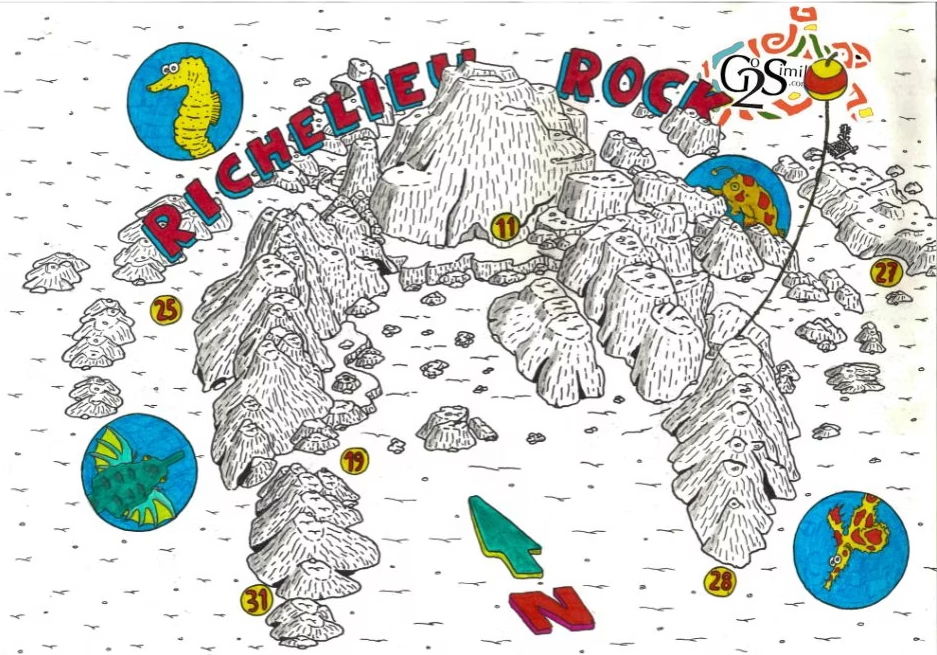
dive site: Richelieu Rock
Surin Islands National Park
Dive Site Name |
Richelieu Rock |
Also Known As |
Hin Plo Naam (Thai name meaning ‘the floating stone’); occasionally called ‘the Jewel of the Andaman Sea’ |
Island / Area |
Mu Ko Surin National Park, Phang Nga Province. An isolated submerged pinnacle approximately 18 km east of Ko Surin Tai in the Andaman Sea. Surin Islands visible on the horizon |
GPS Latitude |
9.36333 |
GPS Longitude |
98.02194 |
Site Type |
Submerged limestone pinnacle, horseshoe-shaped. Sheer walls and overhangs on the north and west; gentle sloping reef on the south (inside of the horseshoe). Numerous small caves, crevices, and scattered satellite pinnacles. |
Access |
Boat only — day trip or liveaboard. No shore entry. You can find our current day trip schedule here. |
Depth and Conditions
Minimum Depth |
5 m (top of the main pinnacles at high tide; the highest rock breaks the surface at low tide) | |
Maximum Depth |
35 m (sand bottom around the base of the pinnacle) | |
Average Depth |
18–22 m (where most divers spend the majority of the dive, exploring the walls and crevices) | |
Typical Visibility |
15–30 m. Visibility varies considerably: plankton-rich water reduces it to 10–15 m but dramatically increases the chance of whale shark encounters. Clearest conditions are typically December–January. | |
Current |
Variable and site-specific. The exposed open-ocean position means currents can arrive from any direction and change within a dive. Mild to moderate on most days; occasionally strong on the north and west walls. An experienced divemaster is essential for reading conditions on the day. | |
Water Temperature |
|
|
Best Season |
Late October to April. Peak visibility is December–January; peak whale shark season is February–April when plankton blooms concentrate at the surface. | |
Best Time of Day |
Early morning for calmest surface conditions and best light. The site can become busy with multiple liveaboards mid-morning; an early entry gives you the site at its quietest and most magical. |
Diver Suitability
Minimum Certification |
PADI Advanced Open Water Diver strongly recommended. The exposed location, variable currents, and depth (best features at 18–28 m) place this beyond the comfort zone of newly certified Open Water. | |
Recommended Experience |
30+ dives. Experience in open-water conditions and mild current is valuable. It is not unusual to complete the Advanced Open Water certification on this site, but that is a decision for the instructor, based on your skill level in previous dives. | |
Suitable for Beginners? |
|
|
Suitable for Advanced? |
Yes, fully. Advanced certified divers can explore the complete depth range, spend time on the deeper north and west walls, and navigate the full horseshoe layout over two dives. This is the site that justifies the Advanced certification. | |
Snorkelling Viable? |
|
Suitability Summary
Richelieu Rock is best suited to Advanced Open Water certified divers and above with at least 30 logged dives and some experience of open-water conditions. The site’s rewards — its extraordinary biodiversity, the horseshoe layout, and the possibility of whale shark encounters — are fully accessible to any experienced recreational diver who respects the conditions on the day. Open Water certified divers who are comfortable in current and have 20+ dives can visit with close supervision; it is not a site for newly certified divers making their first post-course dives.
SITE DESCRIPTION – Richelieu Rock
OVERVIEW — WHAT MAKES THIS SITE SPECIAL
Richelieu Rock is Thailand’s most famous dive site and one of the finest in the world. It sits alone in the Andaman Sea, 18 km east of the Surin Islands, with no land nearby — just a single limestone pinnacle rising from a sandy seabed at 35 m to break the surface at low tide. Jacques Cousteau explored and celebrated this site. The name comes from Admiral Richelieu, a Royal Thai Navy commander who completed the first hydrographic survey of the Andaman Sea in the early 1900s.
What makes Richelieu genuinely exceptional is the density and diversity of life packed onto a relatively compact structure. It offers macro and wide-angle photography, pelagic action and critter hunting, reef fish in abundance and open-ocean giants — all in the same dive. Most liveaboards schedule two or three dives here, and most divers leave wishing they had more time. If you dive Thailand, you dive Richelieu Rock.
DIVE ROUTE / LAYOUT
The site is horseshoe-shaped (sometimes described as croissant-shaped), open to the east, with the deepest and most dramatic terrain on the north and west walls and the sheltered, shallower reef on the south and inside of the horseshoe. There is one fixed descent line which often has one or more speedboats on it. Liveaboards will use dinghies to take divers from the boat, dropping into 15–20 m of water on the descent line. If you are on a speedboat daytrip, you will swim along a trail line from the back of the speedboat to the descent line.
The standard first dive heads anti-clockwise from the descent line, following the north wall at depth before ascending along the western wall. The north side drops steeply with overhangs, crevices, and dense soft coral. As you round the pinnacle the wall softens and a series of satellite pinnacles to the northwest offer additional structure covered in soft corals and glassfish clouds. A second dive typically heads clockwise, following the wall around to the south side and into the inside of the horseshoe — shallower, calmer, and productive for macro. A short cut-through passage leads back from the outer wall into the horseshoe interior. Marine life continues almost to the surface, making safety stops genuinely rewarding rather than merely obligatory.
HIGHLIGHTS & UNIQUE FEATURES
The sheer concentration of life is the defining characteristic of Richelieu Rock: there is almost nowhere you can look without seeing something worth slowing down for. The outer walls are blanketed in purple, red, and yellow soft corals, enormous sea fans, and barrel sponges. The crevices and small caves throughout the structure shelter an extraordinary cast of critters — tigertail seahorses occupy known spots on the south-west side of the horseshoe; harlequin shrimps are reliably found in at least one or two locations on any given day; ornate ghost pipefish drift near crinoids; frogfish cling to encrusted surfaces doing a convincing impression of sponges.
Above and around the rock, large schools of chevron barracuda (Sphyraena putnamae) orbit in tight formations, hunting fusiliers and glassfish. Giant trevally (Caranx ignobilis) and rainbow runners charge through from the open water. Manta rays pass through in season, and whale sharks — drawn by the plankton blooms that also reduce visibility — are a realistic possibility on any dive between February and April. The tomato clownfish (Amphiprion frenatus), rare in the Andaman Sea, has been recorded here nesting in anemones on the inner horseshoe walls.
Marine Life at Richelieu Rock
REGULARLY SEEN SPECIES
- Fish: Chevron barracuda (Sphyraena putnamae) in large schooling formations around the pinnacle. Giant trevally (Caranx ignobilis) and bluefin trevally (Caranx melampygus) hunting in the mid-water. Rainbow runners (Elagatis bipinnulata) in open water. Five-line snappers (Lutjanus quinquelineatus) and yellowback fusiliers (Caesio teres) in dense schools. Brown-marbled grouper (Epinephelus fuscoguttatus) on the deeper walls. Scorpionfish (Scorpaena spp.) and lionfish (Pterois volitans) in crevices. Batfish (Platax teira), angelfish, triggerfish, and moray eels throughout the site.
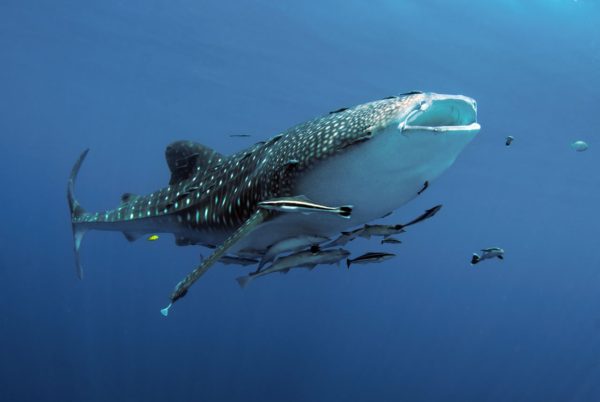
- Sharks / Rays: Whitetip reef sharks (Triaenodon obesus) patrol the base of the pinnacle and rest in crevices. Whale sharks (Rhincodon typus) are the headline attraction — most likely February to April but possible from November onwards. Manta rays (Mobula birostris) pass through, most frequently October–November and February–April. Porcupine rays (Urogymnus asperrimus) on the sand.
- Critters & Macro: Tigertail seahorse (Hippocampus comes) — resident individuals known to local guides on the south-west side of the horseshoe. Harlequin shrimp (Hymenocera picta) in pairs in crevices. Ornate ghost pipefish (Solenostomus paradoxus) near crinoids. Frogfish (Antennarius spp.) on encrusted surfaces. Peacock mantis shrimp (Odontodactylus scyllarus) in rubble. Cuttlefish (Sepia spp.) on the outer walls, often displaying or mating. Octopus (Octopus cyanea) in crevices. Tomato clownfish (Amphiprion frenatus) in anemones — a rare Andaman Sea record. Tiger cowrie shells (Cypraea tigris) on gorgonians. Nudibranchs (Chromodoris spp. and others) throughout.
- Coral: Dense purple, red, pink, and yellow soft corals cover the walls and are one of the visual signatures of the site. Large gorgonian sea fans throughout. Barrel sponges on the deeper sections. Hard coral and anemone fields on the inner horseshoe and shallower areas. Sea whips and feather stars on the walls.
SEASONAL / PELAGIC HIGHLIGHTS
Whale sharks (Rhincodon typus) are the defining seasonal highlight at Richelieu Rock. They are drawn by plankton blooms that accumulate at the surface, and are most reliably encountered between February and April, though sightings have been recorded throughout the season from October onwards. Counterintuitively, lower-visibility days — when the water is soupy with plankton — are often the best whale shark days. Manta rays (Mobula birostris) tend to appear at the season opener in October–November and again in February–April.
One of the more exciting and guaranteed sights is the large schools of long nosed Emperor fish (Lethrinus olivaceus), swimming with Trevally and Giant Trevally (Caranx ignobilis) in an almost Mafia-style mob that cruise by in their hundreds looking for prey. The emperor fish change colour while hunting, from a plain silver to an almost camoflaged mottled pattern.
Dogtooth tuna (Gymnosarda unicolor) and large pelagics become notably more active when current is running. Cuttlefish (Sepia spp.) are frequently observed in courtship and mating behaviour on the outer walls — one of the more remarkable sights in a site that never runs short of them. October and November, when the park first opens after the monsoon, can produce exceptional encounters as animals re-establish at the site after six months of undisturbed quiet.
PHOTOGRAPHY NOTES
Richelieu Rock presents the classic photographer’s dilemma: bring the wide-angle or the macro? The honest answer is both — though if you can only choose one, wide-angle wins on most days because the schooling fish, wall colour, and potential whale shark encounters are irreplaceable opportunities. A fisheye or 10–17 mm zoom captures the full sweep of the soft-coral walls and delivers dramatic split-level shots at safety-stop depth.
For macro, slow down on the inside of the horseshoe and the south-west crevice zone. The known seahorse spots are frequented by many cameras — limit your time and do not use strobes directly on seahorse eyes, which are highly light-sensitive. Harlequin shrimps are usually in pairs and approachable with patience; ghost pipefish near crinoids benefit from a snooted light to separate them from the background. Shooting the barracuda schools from below against the light-filled surface produces some of the most striking images in Thai diving. On whale shark days, switch to wide-angle immediately and use available light only.
Suitability Summary
Richeleiu Rock is beautiful and awe-inspiring but can be challenging, especially on days with low visibility or strong currents. Strong currents are not too common, but you need to have the ability to kick into current and drift comfortably. There is so much amazing marine life that it’s easy to get distracted, so good buoyancy skills are essential. Cameras are not allowed for Open Water divers or divers with less than 40 dives.
Richelieu Rock FAQ’s
Is Richelieu Rock suitable for beginner divers?
Richelieu Rock is not recommended for newly certified Open Water divers. The site sits in open ocean with no land or shelter nearby, currents are variable and can arrive unexpectedly, and the most rewarding sections of the dive are between 18 and 28 m. Advanced Open Water certification is strongly recommended. Open Water certified divers with 20+ logged dives and some open-water experience can dive the shallower areas with a guide. For beginner or newly certified divers on a Surin Islands trip, the calmer dive sites around the islands themselves are a better starting point.
What marine life can I see at Richelieu Rock?
Richelieu Rock is genuinely one of the most species-diverse dive sites in Asia. Reliable sightings include large schools of chevron barracuda, giant and bluefin trevally, long nosed emperor fish, whitetip reef sharks, moray eels, and dense soft-coral walls covered in nudibranchs and anemones. Macro highlights include tigertail seahorses, harlequin shrimps, ornate ghost pipefish, frogfish, peacock mantis shrimps, and mating cuttlefish. Between February and April, whale sharks are a possibility. Manta rays appear seasonally. The rare tomato clownfish nests in anemones on the inner horseshoe.
What is the best time of year to dive Richelieu Rock?
Richelieu Rock is within the Mu Ko Surin National Park, which opens mid-October and closes mid-May. The park closes completely from approximately 16 May to 15 October due to the south-west monsoon. Within the season, December and January offer the best visibility (often 25–30 m). February to April is the best chance of seeing whale sharks — visibility may drop to 10–15 m on the best whale shark days, which is a trade-off experienced divers learn to embrace. The October–November season opener is excellent for manta rays and delivers the site in unspoiled post-monsoon condition.
How deep is Richelieu Rock?
The top of the main pinnacle breaks the surface at low tide by approximately 1 m and sits 1–2 m below the surface at high tide. From there it drops continuously to a sand bottom at 35 m. The most productive diving — where the soft coral density, crevice life, and pelagic action are concentrated — takes place between 15 and 28 m. Advanced Open Water certification (30 m limit) allows access to the full site. Open Water certified divers (18 m limit) can enjoy the shallower walls, the inner horseshoe, and the macro life in the crevices, though they miss the deeper wall sections.
Can I snorkel at Richelieu Rock?
No. Richelieu Rock is almost entirely submerged — breaking the surface by only around 1 metre at low tides — and is surrounded by open ocean. Surface conditions at an exposed open-ocean pinnacle are rarely calm enough for comfortable snorkelling, and the marine life is concentrated on the walls and in crevices at diving depth. This is a scuba site.
Freediving is possible with care, under the supervision of a freeding instructor, for certified freedivers.
What current should I expect at Richelieu Rock?
Currents at Richelieu Rock are variable and site-specific. Because the pinnacle sits alone in open ocean with no island mass to deflect water flow, currents can come from any direction and change within a single dive. Most dives take place in mild to moderate current, which is beneficial — it brings in the pelagic species and keeps the soft corals fully extended. Strong currents occasionally sweep in and we get the ‘green monster’ which is upwellings of cold green water from the deep that create short (approx 1 minute) events of cold water and variable currents. These are not dangerous but you should be prepared for the sudden temperature drop of 5 or more degrees and sudden unexpected current changes during the event.

Ann Christmas
PADI Course Director
Post Author